Chapter I
The Wind & The Storm
March 1009 CE / Rajab 399 AH
·
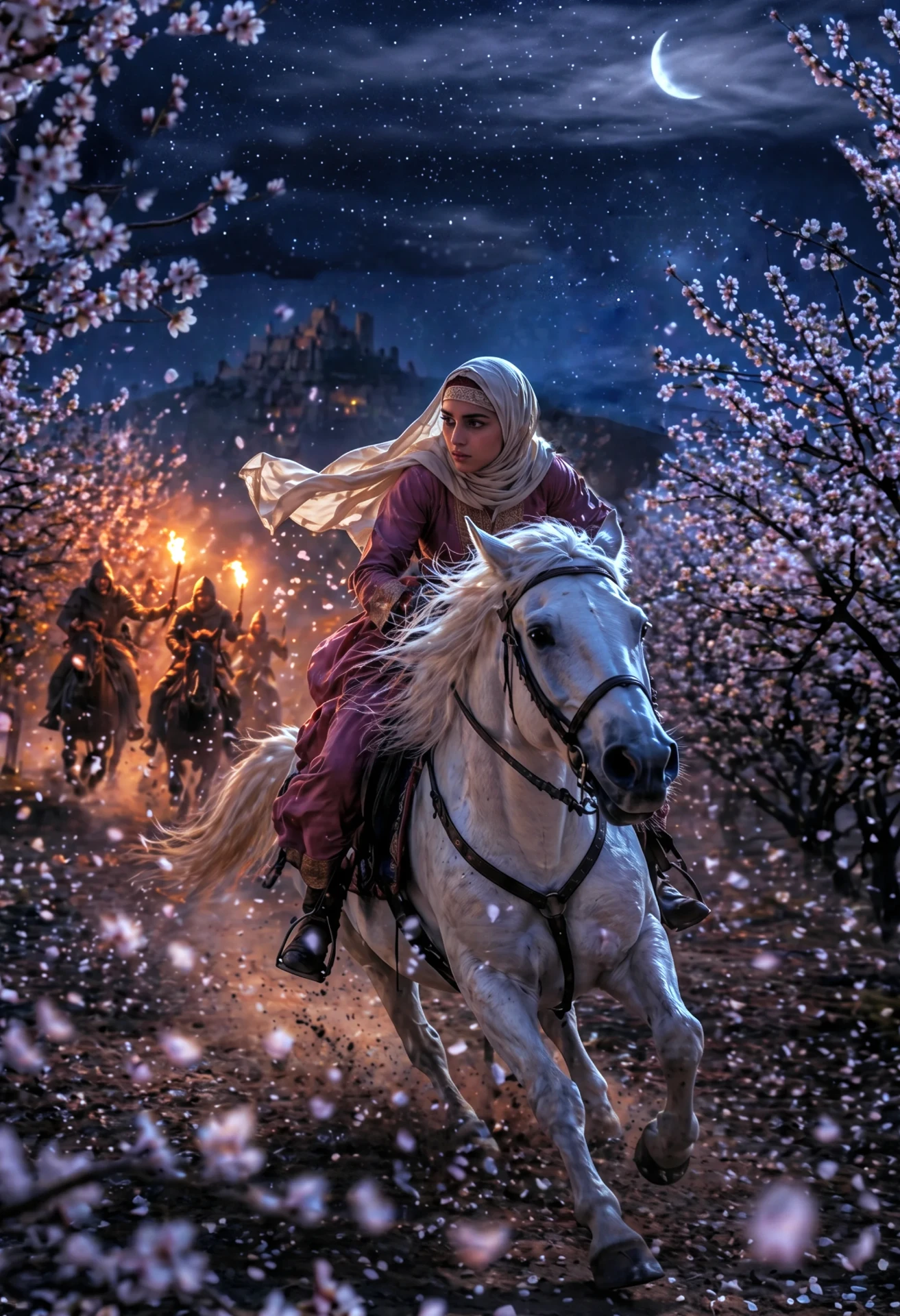
The wind off the Sierra Morena stung Amina’s cheeks as she leaned low over Najma’s neck. Amina rose slightly in her short stirrups, her knees tucked high and pressed firmly into Najma’s flanks in the jineta seat she had practiced since she was small. The position felt natural now, almost instinctive, her body moving in perfect rhythm with the mare’s powerful strides.
“Faster, Najma! Haya!“ Amina urged, her fingers buried in the mare’s white mane.
Ahead of her, a cloud of red dust billowed from the hooves of a massive black stallion. Ahmed was a silhouette of effortless power against the afternoon sun. He didn’t even seem to be trying; he sat his saddle with a grace that made horse and rider appear like a single bronze statue flying through the haze.
The target was a gnarled cork tree that stood at the edge of their father’s olive groves. Amina felt the mare’s heart thundering through the light leather saddle, and for a fleeting moment, thought she was gaining. The gap narrowed, and for the first time since the race began, she could see the fine embroidery on the back of Ahmed’s woolen tunic.
Glancing over his shoulder, Ahmed flashed a grin. With a subtle flick of the reins, he signaled his stallion. The horse surged forward in an explosive burst of speed. In three massive strides, the distance between them doubled. Ahmed reached the tree first, circling it with a triumphant shout and slapping the rough bark before Amina was even within ten paces.
Amina slowed Najma to a trot, relaxed her high-bent knees, and settled back into the seat. Her chest was heaving, her face flushed with heat and the familiar, quiet sting of defeat.
“You nearly had me that time, Amina!” Ahmed laughed as she pulled up beside him. He wasn’t mocking her; his eyes were bright with genuine pride. He reached out and playfully nudged her shoulder. “Truly. Your seat is steadier, and you’ve finally learned to use your legs to guide Najma’s movements instead of forcing her. One day, I’ll be the one riding behind you.”
Amina forced a smile, tucking a stray lock of dark hair back under her khimār. “You say that every time, Ahmed. And every time, you find a hidden wind just as I’m catching up.”
“Because I am your big brother,” he said, puffing out his chest in mock gravitas. “And yet, Father has said your focus is sharper than mine. He says I ride with the strength of a storm, but you ride with the lightness of the wind. The storm breaks things, but the wind finds the gaps.”
Amina looked down at her hands. They were small and slightly calloused from the reins, but compared to Ahmed’s broad palms, they felt fragile and insufficient.
“The wind just blows through, Ahmed,” she whispered, so low he could barely hear. “It doesn’t leave a mark.”
Ahmed was already looking toward the horizon, where the sand-colored walls of their home rose from a white sea of almond trees in full bloom. “Come. Father and Mother will be preparing for tomorrow’s journey. If we are late for supper, Mother will have us both back in our study rooms memorizing poetry until the new moon rises! But first, I need to stop by the forge in Al-Luz to check on the status of the new blade Yahya is crafting for me.”
As they approached the stone houses of Al-Luz, the scent of almond blossoms was replaced by the metallic tang of hot iron and the rhythmic clink-clink-clink of a hammer. Ahmed pulled his stallion to a halt in front of a soot-stained archway where the orange glow of the furnace spilled into the dusty street.
“Wait here, Amina. Yahya promised my new saif would be finished before Father returns. A future Wali cannot lead his men with a practice blade.”
Amina dismounted, her knees still stiff from the ride. “I’ll find Zahra,” she said. “She has the silk thread Mother ordered.”
Inside the forge, the heat of the furnace was overpowering. While Ahmed moved toward the anvil to inspect the steel with the intensity of a young lion, Amina slipped into the back courtyard where Zahra was hanging dyed wool to dry.
Zahra looked up, her eyes brightening upon seeing her friend, but they softened when she saw Amina’s slumped shoulders and the way she dragged her feet.
“You lost the race again,” Zahra said simply, not as a taunt, but as a confidant who could read her friend’s heart. “Salaamu alaykum, Sayyida.”
“Wa alaykumus salaam,” Amina said with a sigh as she leaned against a stone pillar. “He is so fast, Zahra. So sure. He speaks to the guards and they stand straighter. He draws a bow and the arrow finds its mark before I’ve even nocked mine. And I... I feel as though I am standing still while the world rushes past.”
Zahra stepped closer, wiping her blue-stained hands on her apron. “You are the daughter of Abdur-Rahman, Amina. He is raising you to uphold his house. Do not let your brother’s shadow make you feel small.”
“But that’s just it,” Amina whispered as she watched at a hawk circle overhead. “It isn’t just the shadow. My father has taught me to navigate the stars, to shoot, and to ride, so that I might weather the storms that are yet to come. But I am terrified that when the time comes to finally spread my wings, I will not find the breeze and soar, but hit a gale and fall.”
Zahra took Amina’s hands softly into her own. “Even the smallest of birds eventually discover their wings, Sayyida. In time, you’ll find yourself gliding on the wind.”
“Amina, we must go!” a voice called out into the courtyard.
Turning, Amina saw her brother leaning against the doorway.
“I’m sorry to interrupt, Zahra,” he said with lowered gaze, “but I must take the little bird home.”
Amina squeezed Zahra’s hand, rolling her eyes as she turned to leave.
“Wait, the thread your mother ordered,” Zahra said, handing her a small linen bag. “And please, convey my salaams to Sayyida Fatima. Tell her we pray for her smooth passage to Córdoba, and for the health of the little one she bears.”
“JazakAllahu khayran, Zahra,” Amina replied. “I will tell her, inshaAllah. Salaamu alaikum.”
“Wa alaikum assalaam,” Zahra whispered. Then, raising her voice to Ahmed: “Do not underestimate her, Sayyid! One day, this little bird may be the one who guides you home.”
The red dust of the foothills still hung in the air, a shimmering veil between Amina and her brother’s back as they reached the arched gate of the Munya. Having stabled the horses, Ahmed ran off to find his friends, while Amina continued on toward the inner courtyard.
The wild mountain air was replaced by the scent of jasmine and damp stone.
“Your riding has improved, ibnati. You are much faster than before.”
Startled, Amina looked up to see her father, Sheikh Abdur-Rahman, Wali of the Mountain Frontier, standing by the central fountain.
“But not fast enough,” Amina sighed, the sting of the race still warm in her chest.
“Salaamu alaykum, Abi,” she said, reaching him and kissing his hand.
“Wa alaykumus salaam,” he replied, beaming down at her. “Ahmed is fast, but speed is a loud virtue, Amina. It announces itself to all. And without wisdom, it leads to disaster. Remember, ‘Hastiness is from Shaytaan.’”
“He is like a storm, Baba. He is much stronger than I will ever be.”
“And that is fine,” the Sheikh responded, his gaze piercing. “Allah made men and women with certain strengths that, when combined, balance and complete one another. But you are like the wind—capable of doing things he never could.”
“Like what?”
“Like sneaking into places quietly and unseen,” he said, poking her playfully in the ribs.
“Baba, stop it!” she giggled.
He then picked up a recurve bow leaning against the marble fountain and handed it to her. “Now, draw.”
Amina obeyed, taking a breath to steady her aim, and released. Thump. The arrow pierced the target thirty yards away, just below the bullseye.
“Not bad,” her father said, lifting her chin with a light touch. His face became serious. “I have taught you to ride and to shoot not so you can be a soldier, but so you are never a victim. In these times of Fitna, a daughter of the House of Abdur-Rahman must be a fortress in her own right. Do you understand your Amanah—the trust I place in you?”
“To guard the home,” Amina whispered.
“To guard yourself,” he corrected. He reached into his belt and pulled out a small, leather-bound case.
“What is it? Amina asked, her voice tinged with curiosity.
“A gift,” he replied.
Inside was a brass astrolabe, the etched kursi and rete as fine as silk.
“Ahmed will carry my sword while I am gone, but you shall have my stars. If you are ever lost, Amina, do not look to the ground, but up to the heavens. Allah has made the map; all you need are the eyes to read it.”
“And it is He who has made the stars for you...” He paused, looking for her to complete the verse.
“...that you may be guided by them in the darkness of the land and sea,” she finished.
“We have certainly made clear the signs…” he continued.
“...for people who have knowledge,” she completed.
“I’m proud of you, ibnati. Now, go. Your mother awaits you in the Bustan. And remember—”
“Paradise lies beneath her feet” Amina finished as she turned to leave.
Abdur-Rahman smiled and watched as his daughter headed towards the stairwell leading up to the inner garden.
Amina found her mother, Fatima, seated on a low stone bench near the herb beds, sorting dried lavender and strips of willow bark with rhythmic grace, her movements undeterred by the heavy swell of her pregnancy.
“Salaamu alaykum, Ummi,” Amina greeted.
Fatima didn’t look up, but her nose wrinkled slightly. “Wa alaykumus salaam. You smell of dust and horse-sweat, ibnati,” she said, a small, knowing smile tugging at her lips.
“Forgive me, Mother,” Amina said, stepping forward. “I came straight from Al-Luz. I have the silk thread you ordered.”
She handed the neatly tied linen bag to her mother.
“Shukran,” Fatima replied.
“Zahra asked me to convey her salaams,” Amina added softly. “She said that all the village women are praying for you and the little one.”
Fatima’s countenance softened, and she instinctively moved a hand to rest atop the swell of her stomach. “May Allah reward them for their kindness. Their prayers are the best provisions I could hope to take on such a road. Make sure they receive the medicine bundles we prepared for them while I am away.”
“Of course,” Amina said with a nod, “I’ll ensure they get delivered, inshaAllah.”
“Now, sit,” her mother said, patting the stone bench beside her. “Tell me: did Ahmed make you chase him through the olive groves again?”
Amina sat down next to her mother, leaning her head against her shoulder. “He did. And the outcome was no different than any other day. He won, as always.”
Fatima smoothed Amina’s headscarf. “Your brother is a young man of the frontier; he measures worth in lengths of a horse’s stride. But a home is not built on speed. It is built on faith, good manners, and mercy.”
She handed Amina a bunch of dried thyme. “Crush this. Gently.”
Amina obeyed, the scent filling the air. “Mother, Baba says I am like the wind. But the wind just blows through. It doesn’t leave a mark.”
Fatima’s expression hardened. “Your father has seen cities burn, ibnati. He wants you to have a shield, so he teaches you the saddle and the bow. I do not begrudge him that. But remember: a sword only knows how to take. These herbs? They know how to heal, by the permission of Allah. A woman’s mercy is often the only thing that stands between a man and his pride. Now, help me up.”
Amina obliged, offering a hand and assisting her mother to her feet.
“But mercy must also be clean.” Fatima continued. “Go now. Take your bath. Change into fresh clothes, recite your afternoon athkaar, and join us for supper after Maghrib. We must break bread together one last time before tomorrow’s journey.”
“Yes, mother,” Amina said, turning away toward the arched hallways.
Fatima whispered a silent prayer for her daughter as she watched her disappear into the shadows of the house.
Chapter II
The Shepherd & The Wolf
·
In many of the palaces of the nearby governorates, the evening meal had become a grand affair—an ostentatious display of wealth that had spread like an infection from the East. To these rising elites, such ‘refinement’ was a mark of prestige, but in the house of Abdur-Rahman, this ‘New Way’ found no welcome. He rejected the vanity of the Cordoban Elite’s, preferring the humble prophetic traditions passed on by his ancestors. In his central hall, the only seat of honor was a hand-woven rug from Almería, and the only table was a low, wooden mā’ida that forced every man to sit at the same level as his peers, reminding them that they were all equal servants of Allah.
Before the meal began, a servant moved silently through the hall with a silver ewer and basin. Amina watched as her father held his hands over the basin, the cool water cascading over his fingers. He washed with deliberate humility, followed by her mother, her brother and finally herself.
They took their places around the mā’ida, seated on the floor. Sheikh Abdur-Rahman sat in the iftirāsh position—his left foot tucked under him and his right leg upright—the posture of a man who refused to let luxury breed arrogance and in keeping with the example of the Messenger of Allah (ﷺ).
“Bismillah,” Abdur-Rahman said audibly.
“Bismillah,” the others echoed.
The meal began with a light, fragrant soup of lentils and chard served in delicate ceramic bowls. It was a quiet start, designed to prepare the stomach rather than overwhelm it. Since they were young, their father had emphasized the Prophetic tradition of maintaining moderation in all things and never overeating. When the bowls were cleared, a single, large communal platter was placed in the center. It was piled high with tharīd—a traditional Arabian dish of slow-cooked lamb and chickpeas, topped with thin layers of unleavened bread that had soaked up the rich, spiced broth.
Ahmed, his mind clearly adrift in the reports of fitna raging in the nearby provinces, reached toward the center of the dish with his left hand, his fingers hovering over a choice piece of lamb resting on top.
The Sheikh didn’t raise his voice, but he gently tapped the edge of the platter. “Ahmed,” he said, his voice a calm tether. Remember the counsel of the Messenger of Allah (ﷺ): “Mention Allah’s Name, eat with your right hand, and eat from what is in front of you.”
Ahmed pulled back, his cheeks flushing. “Forgive me, Father.”
“Focus on the blessing before you,” the Sheikh said firmly. “The Barakah descends upon the middle of the food, so eat from the sides of the vessel and do not eat from its middle until the edges are finished. There is no haste at this table.”
Amina carefully gathered a small portion of bread from the edge of the platter using only the thumb and the first two fingers of her right hand.
Outside, Najma neighed faintly from the palace stables.
“The almond trees are blooming early this year,” Fatima said, her voice a gentle attempt to anchor the conversation. She reached out and adjusted the fold of Amina’s headscarf with a lingering, motherly touch. “Perhaps it is a sign of a mild spring for our journey, Abdur-Rahman.”
The Sheikh nodded, though his expression remained thoughtful as he gathered a piece of lamb. “A mild spring would be a blessing for the farmers,” he said. “But my journey to the capital is about more than the weather. Since the troubles began in the south, some governors have started carving out their own kingdoms, each thinking he can rule better alone. But when a land becomes divided like that, it is always the farmers, merchants, and shepherds who suffer first. A divided land cannot protect its people.”
“I do not approve of how al-Mahdi took the palace,” Abdur-Rahman sighed, “but I will not stand by and watch the Caliphate collapse into chaos while the people suffer. So I will ride to Córdoba and offer my Bay’ah. For we have learned that sixty years under an unjust ruler are better than a single night without one.”
Ahmed looked up, his eyes bright. “Is that why the mountain passes have been so restless, Abi? The scouts say the bandits are emboldened by the chaos in the south.”
The Sheikh set down his cup of honeyed sharbat and looked at his son, his gaze sharpening. “Bandits are always emboldened when they think the master is distracted. There are reports of a new leader among them—one the locals are calling Adh-Dhi’b. The Wolf.”
Fatima’s hand paused over the platter. “A wolf? Is he truly a threat, or just a nuisance?”
“A nuisance for now,” the Sheikh replied calmly, though his voice held a note of caution. “He is cunning. Until now, his strikes have been limited to relatively small targets, but his incursions have become more regular and increasingly bold in recent weeks. He is a smoldering coal that has only caused minor burns thus far, but even coal can spark an inferno if left unchecked.”
“Then let me hunt him while you are away,” Ahmed said eagerly. “I know these valleys better than any scout. If we show our true strength, he will think twice about raiding our valley again.”
“You will do no such thing,” the Sheikh said, his tone dropping to a resonant, commanding depth.
“Do you think your life belongs only to you, Ahmed? Or that mine belongs only to me? The Messenger of Allah (ﷺ) taught us that every one of us is a shepherd, and every shepherd is responsible for his flock. To the south, in Córdoba, foolish men fight for a worldly throne. But here, in this house, we answer only to Allah, Rabul Arshul Adheem—the Lord of the Magnificent Throne—who will question us about every weaver in the villages, every harvester in the groves, and every servant in this hall. They are my flock today, but while I am away, they are yours.”
The Sheikh leaned forward, the lamplight casting long, serious shadows across his face.
“Do not let your eagerness for a ‘quick victory’ blind you, my son. Remember the slopes of Mount Uhud. The Prophet (ﷺ) stationed the archers on the hill with a command as clear as the midday sun:
‘If you see us get defeated and birds eat from our heads, do not come to assist us. Do not leave your position until I send you word.’ But what did they do when they saw the enemy retreating and the spoils of war scattered on the field? They saw what they thought was a finished battle. They abandoned their position in search of worldly gain, leaving the flank of the believers exposed.”
The Sheikh’s eyes seared into Ahmed’s.
“Because of that single mistake, the enemy was able to strike from behind, and turn a victory into a day of mourning. The Wolf is no different from the horsemen who circled that mountain, Ahmed. He does not want a fair fight. He is waiting for you to hear a howl and chase it, leaving this valley defenseless. He wants the shepherd to abandon his post so he can prey upon the very souls entrusted to our care.”
He reached out, his hand steady on the table. “Your duty is to be the rock and the shield in my absence. Stay within the fortifications and keep the sentries alert. The Wolf is wild, but he is not foolish. He will not strike a palace that is well-guarded, but he will devour a house that forgets its discipline.”
Ahmed looked down at his hands, the fire of his earlier bravado cooled by the weight of the history his father had invoked, but Amina could sense he still desperately desired to prove himself.
Amina watched her brother, seeing the struggle in his face. She then looked to her father and saw a leader who understood the weight of his responsibilities to his flock and the gravity of shifting that mantle, even if only temporarily, to a young shepherd who may not be ready to bear its weight.
He turned then to his daughter, his eyes softening a little but his tone still firm. “In these times of fitna, it is not just the strength of the arm that preserves us, but the steadfastness of our hearts, the strength of our faith, and our reliance upon our Lord.”
He looked at both children, his voice solemn. “Remember: ‘If Allah helps you, none can overcome you; and if He forsakes you, who is there after Him that can help you? And in Allah let believers put their trust.’“
“Amina, you are the heart of this Munya while your mother and I are away,” her father continued. “Ahmed must be the shield, but you must be his trustworthy advisor and supporter. Care for the weak among the farm hands and servants, keep your mind sharp with your studies, hold on to the Book of Allah and let your prayers be the anchor of this house.”
He reached out, his hand covering hers for a brief moment. “A wolf only hunts where he senses weakness. Let him find none here.”
Amina nodded, the weight of her father’s words pressing down upon her.
The rest of the meal was eaten in silence.
Amina looked around the table as she ate. First at Ahmed, who wore a mask of grim determination, lost in thought, a hint of fire in his eyes. He was no longer just her brother, but a young shepherd being tested before his time. Her gaze then landed on her mother, whose calm exterior hid her worries and the silent prayers Amina knew she was already making. Lastly, she looked across at her father, the Slave of the Most Merciful, her rock, and strongest supporter, and she prayed that he would cancel his trip and stay.
With the meal concluded, the family recited the Prophetic supplication of thanks in unison:
“Alhamdu Lillahi llathi at’amana wa saqana wa ja’alana Muslimeen—All praise is due to Allah Who has given us food and drink and made us Muslims.”
“We leave at first light,” Abdur-Rahman announced, rising to his feet. “The horses are rested, and the carriage is prepared. Let us seek rest now. May Allah grant us a safe passage and a swift return.”
“Allahumma ameen,” Amina whispered. “O Allah, let it be so.”
The family of Abdur-Rahman began to file out of the hall as the melodic voice of the palace muezzin began calling the household to the evening prayer. Amina followed her mother toward the inner quarters, the scent of agarwood lingering in the air. She looked out the large arched windows to the valley and the mountains beyond. The threat of the Wolf had been spoken of as a mere nuisance, a shadow on the frontier, but despite the warm breeze, Amina felt a cold shiver she could not explain.
Across the valley, high up in the Sierra Morena, a dark presence stirred.
A hunched figure draped in matted wolf fur knelt before a cairn of ash and stone.
Besides him, a small flame flickered, casting long skeletal shadows across the uneven walls of the cave.
Nearby, a shallow bowl of warm sheep’s blood lay, steaming in the cool mountain air.
“Three winters, Salim” he began, in a low, rumbling voice, staring into the eyeless face of a recently exhumed human skull.
“Three long winters since he took you from me. Since he read out your sentence to that cheering crowd of heathens before the sword fell. Three winters since he announced that justice had been served, the eyes had been cooled and the wronged had been righted”, gently wiping dirt away from the bone.
“But he lied!” he hissed between clenched teeth, his eyes filled with fire.
“Justice cannot be meted out by the unjust! The fiend claims to uphold “The Law”, but the only law, is the law of the forest,” he growled.
“We are no more than beasts. Some die so that others live. A predator cannot be blamed for seeking out its prey. If they died, they did not run fast or far enough. The only ones wronged that day were us.”
“Forgive me, brother,” he whispered as he dipped two fingers into the crimson pool and began to gently paint the ivory skull red.
“Just know, I have not remained idle during our time apart. I have stalked this valley and scented the wind, waiting for the right moment to strike. And the time is finally upon us.” he grinned, flashing yellowed fangs.
“They call him ‘The Shepherd,’ but I am ‘The Wolf,’ and I shall have my vengeance.”
Rising to his feet, the beast slowly turned. His massive frame seemed to swallow the light, dwarfing everything around him. There, hidden in the shadows at the back of the cave, two dozen eyes watched him with a mixture of unholy awe and terror. His loyal pack, recently fed but still hungry for ruin, licked their lips and waited in reverent anticipation for their leader to speak.
Raising the crimson skull above his head, he began a low, rhythmic chant, his voice a rasping growl that filled the hollow of the cave:
“The snake behind the wall has hissed:
‘The master prepares his mount,
And leaves behind a foolish boy,
Prancing all about.’
The trap is set, the lure is primed,
We sense the shifting sands.
We set out with the rising sun,
To feast upon the lambs.
Now rest, my brothers, with steel in hand,
And wait for the new dawn.
For Salim’s sake, we shall take,
And finally right this wrong!”
A chorus of low, guttural howls rang out in response, echoing ominously in the cavernous space.
One by one, the men settled into their furs on the dark, cold stone.
The Wolf stepped to the cave’s mouth bathed in the silver moonlight, his hands still slicked with blood, and looked out towards the jagged peaks and the valleys beyond.
“Sleep well, Abdur-Rahman,” he hissed into the night. “It is the last peaceful night your house will ever know.”
Chapter III
The Vanishing Light
·
After praying Isha and finishing her nightly adhkar, Amina crawled into bed, turned onto her right side and shut her eyes. She lay there in the dark, thinking about her parents and their impending departure, about her brother and her father’s warning, and about herself, and her place in the world.
At some point she drifted off and found herself in a dream, surrounded by darkness, pressing in from all sides. Ahead of her, a bright, orange flame bobbed in the abyss. It was Ahmed, his back straight and his pace relentless, carrying a torch, guiding her through the darkness.
“Faster, Amina!” he called back, his voice muffled and faint in the gloom. “You must catch up!”
Amina hurried after him, her hand shielding a tiny, flickering candle. The flame was so small it could barely illuminate her own feet. She stumbled over invisible stones, her breath coming in shallow gasps. “Ahmed, wait! I cannot see!”
But the torch moved further away, a golden ember being swallowed by the infinity of the night.
Then, without a sound, the light vanished.
“Ahmed?” she called out, coming to an abrupt halt, listening for his voice.
But she was only met with silence.
“Ahmed, stop messing around!” she demanded, a tinge of annoyance masking her rising terror. Her brother had a habit of playing tricks—hiding in dark corners, waiting for the opportune moment to jump out and startle her. “Please, let this be a trick,” she prayed. “Re-emerge. Laugh at me. Just don’t leave me here.”
She turned in panicked circles, scanning for any sign of his silhouette.
But there was nothing. Not a footstep. Not even a gust of air.
Just absolute silence.
Holding her breath, Amina waited—no, hoped—for Ahmed’s hands to grab her. But instead of her brother’s familiar hands, something else began to seize her.
A drowning sense of dread.
Desperate for deliverance, she called out to those closest to her.
“Abi?” she questioned, her voice trailing off into the void.
“Ummi?” she beseeched, her words barely a whisper.
When even her mother did not respond, Amina began to run blindly through the dark void, her heart drumming frantically in her chest. The ground was uneven and treacherous. Her foot caught on a hidden root and she pitched forward. As she hit the ground, her hand flew open and the small candle tumbled into the dirt ahead of her.
She watched in horror as the tiny flame fizzled and went out leaving her in absolute darkness.
Amina lay there motionless, sprawled on the cold, hard earth.
She was alone. Utterly alone in a world without edges.
What started as a whimper soon evolved into wracking sobs that shook her entire being.
Between heaving sobs, she called out to the only one who could hear her at all times. As-Sami, the All-Hearing.
“Ya Rahman...” she whispered into the dirt. “You alone we worship, and you alone we ask for help” The words of the Fatiha flowed from her lips. “Guide us to the Straight Path. The Path of those You have blessed. Not those You are displeased with, or those who are astray.”
As she finished the final ‘Ameen,’ she rubbed away the tears and looked up. Little by little, the ink-black sky began to change. Tiny pinpricks of light began to pierce the gloom. First one, then a dozen, then a thousand. The stars appeared, cold and brilliant, arranged in the patterns her father had traced for her on the ramparts.
“Allah has made the map,” his voice echoed in her mind. “You just need the eyes to read it.”
Amina pushed herself up from the ground, turned toward the North Star and began to walk.
With each step, the ground beneath her feet began to glow. It was faint at first, but as her pace quickened, the path became a shimmering ribbon of light stretching out to the horizon.
The glow intensified. Amina began to run, but this time, she did not stumble. She felt light, as if the wind itself was lifting her heels. Ahead, a hill rose out of the dark, and behind it, piercing rays of gold began to fan out across the sky.
She scrambled up the final slope, her heart thrumming in her chest. As she crested the top, she was enveloped in a sudden, blinding brilliance of a blazing sun that shattered the darkness around her.
She woke with a start, her chest heaving and her hand clutching the edge of her blanket. The room was silent. Outside the lattice, the first hint of grey was touching the Sierra Morena, and from the courtyard below, she heard the clatter of a horse’s hooves.
Chapter IV
The Empty Nest
·
The morning was far from the brilliant golden sunrise of the night before. It was cold and grey and dead. Overnight, a thick mist had rolled down from the Sierra Morena and settled over the valley like a shroud.
In the main courtyard, the atmosphere was thick with the scent of damp wool, horse musk, and the sharp, resinous smoke of pine torches. A royal carriage—a sturdy, cedar-walled vehicle with silken curtains—sat waiting. Twenty elite jinete, their mail shirts glinting dully in the low light, sat motionless on their mounts, spears held skyward.
Amina stood beside Ahmed, wrapped in a white ermine shawl, her breath blooming in small white clouds that dissipated in the cool morning air.
Despite the chill, Sheikh Abdur-Rahman looked every bit the Wali that morning. He wore a traveling cloak of heavy wool, and his blade—the one he had promised Ahmed would be his for the week—was already strapped to Ahmed’s waist.
The Sheikh placed a heavy hand on Ahmed’s shoulder. “The mist is thick, but your mind must remain clear. Remember, my son: the safety of these families is an Amānah from Allah, placed in your hands. Do not let pride be the crack in the gate through which the Wolf enters.”
Ahmed straightened his back, his hand instinctively moving to the hilt of the sword. “I will be the rock, Father. I will not move from these walls until I see your banner returning from the south.”
The Sheikh then turned to Amina. He didn’t speak at first, his dark eyes searching hers. In that gaze, Amina felt he was looking right past her composed exterior to the timid girl who doubted her every step.
“Look to your mother, Amina,” he said softly, nodding toward the carriage where Fatima was already seated, her face a pale, elegant moon behind the curtains. “She carries the wisdom of our house with her. Honor her, and let your Adab be the light that keeps the servants steadfast while we’re gone.”
“I will, father, inshaAllah“ Amina whispered, stepping forward to kiss his hand before heading over to the carriage to bid her mother farewell.
“I wish I were riding with you, Ummi,” Amina whispered, reaching up to clutch her hand through the silk curtains.
Fatima squeezed back, her eyes reflecting a mix of pride and sorrow. “And I wish you were at my side, ibnati. But we have discussed this. The women of Al-Luz and Al-Kahl cannot go two moons without a healer staying among them. If a fever breaks in the villages or a child is born in the middle of the night, they will knock on your door and you must be here to open it. And while your brother bears your father’s sword, he needs your heart to guide his hand. You are the Shepherdess of this house in our absence, Amina. That is your Amānah. Do you understand?”
“Yes, mother,” Amina replied with a nod, her eyes brimming with tears.
Fatima’s grip tightened slightly, and she leaned closer to the curtain. “And Amina... look after Ayah while I’m away. Make sure she has fresh water and seed. Will you do that for me?”
“Of course, Ummi,” Amina whispered, her voice catching. “I promise.”
She forced a smile while secretly praying for the strength to bear the burden placed upon her as she stepped back from the carriage.
Then came Captain Idris, Commander of the Guard.
He stepped out of the shadows near the gatehouse, his helmet tucked under his arm and walked with the confidence of a career soldier. He was a man of forty, with a neatly trimmed beard and eyes that always seemed to be calculating. Upon reaching the Sheikh, he placed his hand over his heart and gave a modest inclination of his head.
“The perimeter is scouted, My Lord Wali,” Idris said, his voice as smooth as polished stone. “The road to the valley is clear. I have doubled the sentries on the North Wall as you commanded. We will guard your children and your house as if they were our own.”
The Sheikh nodded, satisfied. “I trust your steel, Idris. Keep the boy’s head level. I place him in your charge.”
“With my life, My Lord,” Idris replied.
The Sheikh mounted his stallion with a fluid grace that Ahmed still struggled to mimic. With a sharp command, the small caravan began to move. The iron-shod wheels of the carriage groaned against the cobblestones, and the rhythmic clatter of the horses’ hooves echoed off the high walls.
Amina watched until the mist swallowed the last of the rear guard. The heavy oak gates creaked shut with a final, booming thud, and the massive cerrojo bar was dropped into place.
The silence that followed was deafening.
Ahmed stood in the center of the courtyard, his legs spread wide, his hand resting on the sword. He looked at the gates, then at the empty ramparts, and then at Amina. The transition was visible in his eyes—the brother she had played and raced with just the day before was being replaced by the young lord who felt the weight of the mountain pressing down on him.
“Idris!” Ahmed barked, his voice straining with the effort of command.
The Captain appeared at his side instantly. “Sidi?”
“I want a full report from the watchtowers every hour,” Ahmed commanded. “And tell the village elders that if they see so much as a strange dog on the path, they are to send word immediately. I will not have the Wolf sniffing at our heels while my father is away.”
Idris bowed, a thin, unreadable smile playing at the corners of his mouth. “A wise precaution, Sidi Ahmed. You have your father’s spirit.”
Amina watched the two men walk toward the barracks, their shadows stretching long across the damp stone. She felt the brass astrolabe tucked into her sash, a secret weight against her ribs.
She looked up at the grey sky, and for the first time, the Munya felt as if it had lost its soul. As the dust of her parent’s escort settled to the ground, a strange sense of unease grew with the rising sun. Needing to distract herself from her growing worry, Amina made her way up the steps to the middle ward and towards the inner gardens of the Bustān, to seek refuge in her mother’s apothecary, where there was much work to be done.
Her mother’s apothecary was a stone-domed sanctuary at the edge of the meticulously maintained private garden of the Bustān. As she ascended the stairs, the cool mountain breeze was replaced by the heavy scent of Azahar—the first orange blossoms of spring.
Inside the apothecary, she inhaled the familiar aroma of white mulberry leaves and dried herbs. The room felt strangely quiet. Even Ayah, her mother’s sparrow, sat motionless in her brass cage near the latticed window, her small head tucked beneath her wing.
Having reviewed the ledger her mother had left for her, Amina set to work at the mortar and pestle, grinding willow bark for the weavers’ aches and thyme for the chest-coughs that lingered after the winter rains.
As she worked, her mind drifted back to a conversation she had overheard a week prior—the night her father had received the official summons to Córdoba. She had been bringing a tray of mint tea up to her parents’ manzah when she heard her father’s voice through the door, his tone unusually burdened by the weight of the Fitna outside their walls.
“The world is changing, Fatima. The borders are shifting like the dunes of the Maghreb. If the chaos from the south creeps into our valley, I would feel better knowing Amina was anchored to a house of strength. The son of the Wali of Jaén is a man of noble character and scholarship. A betrothal would give her a shield I may not always be able to provide.”
Amina held her breath, the tray heavy in her hands, keen to hear her mother’s response.
“She is fourteen, Abdur-Rahman.” Her mother’s tone was soft, but firm. “By the law, she is a woman. But the heart requires its own season to bloom. Grant her two more winters to find her own footing. Let her finish her studies as a copyist and a healer, and her memorization of the Qur’an. A woman who enters a marriage with wisdom is a blessing to her husband; a child who enters it is merely a burden. We should not clip her wings before she has even learned to fly.”
Amina remembered standing in the hallway, her heart a confusing tangle of emotions. Her father had eventually relented, his voice softening with the deep gheerah he felt for his only daughter. “Two winters, then. We will not speak of suitors until the orange groves have fruited twice more. May Allah grant us that time.”
“Ameen,” Amina had whispered into the cooling steam.
In her world, marriage was not a thing to be feared but a rite of passage—the sacred moment she would become the matriarch of her own sanctuary. She looked forward to a companion of the soul who would value both her mind and her faith. But as she looked down at her hands, stained with the ink of her studies and her mother’s herbs, she questioned if she was ready to set them aside for the keys to a new house just yet. Her reluctance was not a rebellion against her father’s wishes, but a yearning to first prove to herself—and to her Lord—that she could fulfill the Amānah of her parents’ teachings here, in the valley of her birth.
To Amina, this trust was not a decree of confinement, but a call to excellence. She didn’t merely want to be a passenger in her future home; she wished to be its heart and its anchor—a garment shielding her husband’s honor and a sanctuary of tranquility for him in a world of Fitna. She recognized that while a husband was the protector of the perimeter, a wife was the shepherdess of the souls within the walls. She wanted to ensure that when her time finally came, she possessed the steady character and the depth of wisdom required to guide such a flock, rather than entering that sacred space as a child who still relied on others to find her way.
Amina’s fingers paused over the mortar, the pestle going still.
The memory of that night didn’t end with her own future; it had shifted to the one person she looked up to most.
“And what of Ahmed?” her mother had asked, her voice tinged with a different kind of worry. “He turns eighteen in two months’ time, yet he is still unwed. Nearly all the other sons of the Walis in the other governorates are already wed or engaged. If we wait much longer, the other houses will think there is a weakness in our line.”
“Ahmed has the heart of a lion, Fatima, but the mind of a summer storm,” her father had sighed. “You know as well as I how impulsive he is. A husband and a father must be the shepherd of his people; he must be responsible, patient, and far-seeing. Our son still needs time to grow up before he can lead a household of his own.”
“Then why leave him now?” Fatima had pressed, her voice rising with the instinct of a mother sensing a predator. “You know how restless the frontier has become. If he is not ready for a wife, is he truly ready for the weight of this valley?”
“I have no choice,” the Sheikh replied, the finality of the Wali returning to his tone. “The summons to Córdoba is mandatory. If I fail to appear, the Caliph will suspect that I, too, have rebelled. The palace needs a head while I am away, and the people need to see their future leader. But he will not be alone, Fatima. I have entrusted him to Idris. The man has remained loyal for twenty years while foolish men have betrayed their lords. Idris is the anvil upon which Ahmed’s iron will be forged.”
There was a long silence before her father added the words that now felt like a leaden weight bearing down on her: “And he has Amina. She has the focus he lacks. I have told him to seek her counsel and take his sister as a moral anchor in our absence. This is his first true test of character and leadership. He will never grow into the man he needs to become unless he is given the opportunity to bear the weight.”
The memory lingered in the air as she looked down at the neat row of surraat—the small cloth bundles of medicine tied with twine—that she had promised to deliver to the sick womenfolk of Al-Luz before her mother left. Each was labeled in her mother’s elegant script, the reminder causing a sudden pang of worry to surge through her as she thought about how her mother was faring on the journey to the capital.
Fatima bint Yusuf was a woman of unwavering principle and a discernment that had spread far beyond the walls of the Munya. Amina remembered the stories her aunties whispered: of how Fatima, in her youth, had turned down suitors from the wealthiest kingdoms—men who arrived with caravans of gold but souls parched of faith. Her mother had sought a man who understood that power was a loan from the Almighty, not a possession to be flaunted. She had found that rare integrity in Abdur-Rahmān. He was a man of the frontier, but he carried the humility of a traveler in this dunya, never letting his title of Wali Ath-Thughar Al-Jabali—Guardian of the Mountain Frontiers—distract him from his responsibilities to his Lord or his people.
This was the balance that defined Amina’s life. Her mother was her “North Star” of refinement, teaching her that a lady’s true strength was found in her faith and adab—the grace with which she managed a household, the care she showed for her family and the mercy she extended to the sick. Fatima often fretted over the callouses on Amina’s hands, preferring her to master the reed pen and the mortar rather than the bow and the saddle.
“A woman’s hand is for mending, ibnati,” her mother would say with a gentle sigh. “Your father prepares you for a world of storms, while I try to prepare you to maintain a garden of peace.”
Amina respected those boundaries. She took pride in her role as a calligrapher, copyist and a healer-in-training, knowing that the preservation of knowledge and the service of others was a sacred act. She knew how to direct the servants, not with a shout, but with the same quiet dignity her mother used, treating the humblest farmhand or destitute beggar as a soul worthy of honor. Her parents had taught her that wealth was a test of character. It was better to be self-sufficient and serve others than to be served and become soft.
Yet, as she looked at the faint yellow stains of turmeric and the callouses on her fingers, Amina felt the conflicting pull of her two worlds. Her father’s words at the fountain yesterday still echoed in the quiet of the apothecary: A daughter of this house must be a fortress in her own right. He had seen the Fitna on the horizon creeping steadily toward their borders and had demanded she never become a victim. He had trained her in the saddle and with the bow not to compete with the men, but as a safeguard against a world that preyed upon the weak and unprepared.
Amina loved the feeling of the wind on her face and the satisfying thump of an arrow finding its mark, but here, surrounded by her mother’s ceramic jars, the role of a defender felt like a heavy armor she wasn’t sure she was meant to wear. Was she to be the hand that drew the string, or the hand that ground the medicine? She felt suspended between two versions of herself—the healer and the sentinel—praying that she would never have to choose between them.
Her gaze shifted to a smaller, empty jar on the shelf, and her heart grew heavy with a familiar sorrow. Despite her mother’s well of medical knowledge, she could only dampen the grief that had visited their house so many times. Amina thought of the years of silent mourning. Since Amina’s own birth, her mother had carried four other lives, but each time, the cradle had remained empty.
She reached out to touch a jar of dried rose petals, a scent her mother loved, and the fragrance seemed to sharpen her regret. She had wanted to ride in that carriage, to hold her mother’s hand through every jarring bump of the road. But the carriage had been a fragile hive, crowded with maidwomen, cushions, and the desperate needs of a woman whose body had already failed her four times before. There had been no room for a daughter’s comfort when a miracle was being transported through a world of Fitna.
Fatima had accepted each loss with staggering Sabr, her faith a rock that the waves of grief could not break. But Amina had seen the lines of age deepen around her mother’s eyes. She knew this current pregnancy was the reason for the grueling journey to Córdoba just as much as her father’s political duty. It was the miracle they all held their breath for, yet the frontier infirmary was no place for a birth so fraught with complication. Between her mother’s weary body and her father’s solemn quest to steady a crumbling Caliphate, the stakes of their travel felt almost too great for the horizon to hold.
“She carries our future on that road,” Amina thought, her hand trembling as she set down the pestle. “And she carries it with a smile, while I stay behind and fear the shadows.”
She sat there in silence, a mere shadow of her mother’s patience and her father’s strength. But as the midday sun hit the white marble of the apothecary floor, she knew she could not stay there wallowing in self-doubt.
She might not have the strength of her father, nor the poise of her mother, but she was the daughter of both. And she would do her best to fulfill the Amānah they had placed on her shoulders in their absence.
As she stood to leave, a soft chirp broke the silence. Amina turned. Ayah had lifted her head, ruffling her brown feathers. The little sparrow beat her wings once against the brass bars of her cage before settling back onto her perch with a quiet trill.
The bird had been silent the entire time Amina worked—almost as if she, too, felt the weight of Fatima’s absence.
Amina approached the cage slowly and slipped a finger through the bars. Ayah hopped closer and gently pecked at Amina’s fingertip.
“You miss her too, don’t you?” she whispered.
Ayah chirped again, as if in answer.
Amina refreshed the bird’s water and scattered fresh seed into the brass dish at the bottom of the cage. “I’ll take care of you while she’s gone,” she promised softly. “Just as she would want.”
Ayah tilted her head once more, then settled onto her perch with a contented ruffle of feathers. And for a moment, Amina felt a little less alone.
Chapter V
A View from Above
·
Outside the apothecary, Amina knelt in the dirt to inspect the alcorques, her silk khimar brushing the ground as she checked the shallow basins around each lemon tree, ensuring the precious water would reach the thirsty roots. As part of her studies in agronomy, she had learned from the Calendar of Córdoba of Arib ibn Sa’id and the eastern manuals of Ibn Wahshiyya how to concentrate moisture and prevent waste. In Al-Andalus, water was more than a resource; it was a sacred trust.
With the sun at its zenith, the voice of the palace muezzin called out to the faithful, “Come to prayer, come to success.” Amina abruptly stopped what she was doing, gathered her skirts and hastened back to her chambers in the upper residence to perform her midday prayers. Since she was young, her parents had both emphasized the importance of salah. Just the other day, she had finished memorizing the hadith of Abdullah ibn Mas’ud in which the Messenger of Allah ﷺ taught his companions that the best deeds were, prayer on time, good treatment of parents and ensuring the people are safe from one’s tongue.
After making wudu and adjusting her khimar, Amina turned towards Makkah and tried to forget about her worries. Raising her hands to her shoulders she began the prayer with the opening takbir: “Allahu Akbar–Allah is the Greatest”
Upon completing her Salah, Amina remained kneeling on her prayer rug in silent contemplation. She raised her hands, palms open toward the heavens, and whispered her supplications to Al-Hafidh, the Protector.
“O Allah, Protector of the travelers and the stationary alike, grant my mother and father a smooth journey and make its distance easy for them. O Allah, You are their Companion on the road and the One in Whose care they have left their children. O Allah, protect them from the hardships of the way, and from all wicked sights, and from finding their family and property in misfortune upon returning.”
She paused, raising her face to the sky beyond the cedar lattice.
“O Allah, make this journey a means of goodness and piety. Lighten their burdens and bring them back to us in safety. To You is the final return, and in You alone we have placed our trust.”
“Ameen,” she concluded, “O Allah, let it be so.”
After finishing her adhkar, Amina walked out to the balcony of the upper residence, her fingers tracing the cool, smooth surface of the marble balustrade. Behind her, the warm, cream-colored stone of the palace facade almost glowed under the mid-March sun, a striking contrast to the rugged tan of the ramparts and the jagged contours of the Sierra Morena beyond.
She looked out across the expansive terraces, orchards and waterways stretching out into the valley below and could not help but reflect on the verse: “And He is the One Who spread out the earth and placed firm mountains and rivers upon it, and created fruits of every kind in pairs. He covers the day with the night. Surely in this are signs for those who reflect.”
To any guest, this was a place of impossible luxury, but to Amina, it was a sacred trust—one she was now responsible for helping maintain in her parents’ absence.
From the edge of the terrace, the sounds of the valley rose to meet her including the constant, rhythmic groan and splash of the massive wooden Noria. The waterwheel lifted the river’s bounty into the silver ribbons of the acequias that fed the green valley below year-round. Standing beside the primary sluice gate was the Amin al-Ma’, the Water Steward. Second only to her father, he was the man whose integrity was the valley’s lifeblood.
While her father held the sword of command and the Qadi held the book of law, the Water Steward held the keys to the valley’s survival. In mid-March, his work was feverish; he was overseeing dozens of fallaheen who were waist-deep in the channels, clearing out the heavy mountain silt and winter debris before the full spring snowmelt arrived. He was the arbiter of the soil, the man whose fairness ensured that the smallest vegetable plot in Al-Luz received its fair share alongside the great orchards of the palace. To the farmhands, his word was as final as a decree from Córdoba.
Nearby, the Almotacén, the market inspector, was supervising the opening of a matmora—an underground grain silo hidden beneath the stone flags. He moved with clinical precision, checking the winter wheat reserves and ensuring the massive green-and-white tinaja of olive oil were sealed tight. He was the guardian of the valley’s weights and measures, ensuring that even in the absence of the Wali, the settlement’s prosperity remained uncorrupted by greed.
Amina’s eyes shifted to the lower ward, where the scent of horse-sweat and alfalfa rose from the stables. She saw Zayd, the Sahib Al-Khayl, moving among the Spanish Jennets with a quiet, rugged authority. To the soldiers, he was the Master of the Horse, but to Amina, he was the one who had taught her how to fly.
He was the man who had first placed her in a double-pommeled saddle when her legs were still too short to reach the stirrups. It was Zayd who had spent countless dusty afternoons in the training paddock helping her perfect the agile jinete position that let her soar through the wind.
“Higher with the knees, ya Usfur,” he would say, his hand steadying the horse’s neck. “Balance is not found in the hands, but in the heart and the heels.” Under his watchful eye, she had learned to glide above the saddle rather than deep, allowing her to become one with the rhythm of a galloping horse.
Beside the stable arch, she caught a glimpse of a familiar white tail swishing in the shadows—Najma. Amina’s heart gave a soft thud of affection. She remembered the morning of Eid al-Adha three years prior, the sun barely rising as her father led the white mare into the courtyard, her coat so radiant she looked like a piece of the moon had fallen to earth. It was the greatest gift her father had ever bestowed upon her, a sign of his immense trust. Since that day, Zayd had cared for the mare as if she were his own kin, grinding the finest barley for her feed and mixing specialized poultices and cooling herbs to ensure her legs remained strong.
Beyond the stables, the sounds of industry filled the air: the rhythmic thump-thump of the weavers working their mallets to finish the last of the heavy wool fardas before the spring shearing, and the distant, metallic clink of the blacksmiths at the forge, turning iron into iron plowshares and arrowheads.
Her eyes drifted toward the eastern slope, where the village of Al-Luz sat nestled like a bird’s nest in the heart of the almond orchards. From this height, the village seemed to be floating on a sea of snow, the white blossoms of the trees so thick they nearly obscured the stone houses. She could see the thin columns of smoke rising from the communal ovens and the women of the village gathered near the white mulberry trees, preparing the wicker trays for the silkworm hatching.
She looked for the soot-stained archway of the forge, where Yahya would be standing over his anvil. Seeing the forge always brought a sharp, bittersweet memory to the surface. Two winters ago, the village had been gripped by a wasting lung-fever. Amina and her mother had spent weeks in the village, moving from house to house, but they had spent the most time in Yahya’s small, smoke-scented home.
Amina closed her eyes, remembering the smell of vinegar compresses and the heavy, earthy scent of the boiling herbs they had used to treat Zahra’s mother. She remembered the long heartfelt vigils she had shared with Zahra, the two of them huddled together in the corner of the room while Fatima whispered prayers over the dying woman. Though Zahra’s mother had succumbed to the sickness, a different kind of life had been born in that room. The bond of shared grief and the long nights of service had forged a sisterhood between Amina and Zahra that defied the distance between the palace and the forge. Despite the difference in their clothes and the titles their fathers held, Zahra was the only soul in the valley who truly knew the girl behind the Wali’s daughter.
Amina felt a strange sense of kinship with everyone in the valley. Over the years, accompanying her mother on these medical rounds, she had learned their names, their struggles, and the rough, clicking cadences of the Tamazight dialect spoken by the Berber shepherds who brought their flocks down from the mountains. She wasn’t just a “princess” to them; she was the girl who had sat in their kitchens learning the earthy smell of reeling silk and hearing the stories of the old women.
Her gaze climbed higher, past the white canopy of Al-Luz to the grey, jagged spurs of the upper range. There, perched like a stone falcon upon the cliffs, sat the fortified hamlet of Al-Ma’adin. Even from this distance, the town looked more like a fortress than a settlement. Its walls were thick and unadorned, built from the same dark schist as the mountain itself, and crowned by the tallest of the Burūj.
While Al-Luz provided the olives, almonds, and silk, and Al-Kahl provided the wheat, textiles, and tools, Al-Ma’adin was the heart of the valley’s wealth and gateway to the legendary silver mines of Ayn al-Fidda. Even from this distance, she could see the glint of sunlight off the spears of the sentries patrolling the ramparts. In Al-Luz and Al-Kahl, the soldiers made occasional patrols, but in Al-Ma’adin, they were a permanent fixture. No mule train left those gates without an escort of twenty men en route to the munya’s vault, for while the almond blossoms of the valley were beautiful, it was the silver of the heights that drew the eyes of the bandits.
Her gaze shifted to the lower ramparts of the Dar al-Jund, the unadorned stone barracks. There, she saw Ahmed standing with Captain Idris, his silver-trimmed tunic a bright spark against the tan walls of tapial. Ahmed was gesturing toward the horizon, his hand resting on the hilt of their father’s sword. Even from this height, Amina could see the blade was too large for him, sitting heavy and awkward at his hip.
Ahmed was a storm, eager to meet the world with steel. But as Amina looked past the fortified core of the Munya to the open, unwalled fields of Al-Kahl, she saw the “beautiful fragility” her father had warned about. There was no perimeter wall to protect the wheat or the weavers. There were only the Burūj—the web of watchtowers crowning the peaks.
As much as she admired the view, there was still much work to be done. Turning from the vista, she began to make her way down through the halls of the residence to her study to begin her midday task: her role as a copyist. She did not wander aimlessly, but moved with the practiced step of a daughter who had been taught that waqār and haya—refined grace and modesty—were behaviors to be upheld. Her soft leather khuff boots made almost no sound as she crossed the polished marble floor.
Reaching the lower levels she passed through the heavy arched doors that opened up into the Diwan Al-Amm, the great council hall that served as the administrative heart of the province. Usually, this space was a hive of controlled chaos—the air thick with the scents of cedar ink and the persistent, low murmur of petitioners, village elders, and water-officials. She was used to seeing her father seated on the central dikka, his presence a steady anchor. To his right, the Qadi would have been surrounded by leather-bound volumes of Islamic Jurisprudence. To his left, the Katib would have been bent over a low desk, recording every tax grain, ounce of silver and every drop of water allocated from the mountains.
But today, the hall stood in an eerie, hollow silence that made Amina’s skin shiver. The high horseshoe arches, decorated with intricate geometric plasterwork, seemed to stretch further into the shadows than they did when the room was full of voices. The empty desks of the scribe and the judge were a stark reminder of her father’s thoroughness, and the vulnerability of the house he had left behind. He had sent the Qadi and the Katib ahead two days prior, a vanguard of law and ink to coordinate with the central court in Córdoba and ensure the Wali’s residence was prepared for their arrival. They had taken the official seals and the heavy ledgers with them, leaving the Diwan stripped of its intellectual weight.
As a shaft of sunlight pierced the high clerestory windows, illuminating the dust motes dancing over her father’s empty seat, Amina’s heart dropped with realization that the intellectual heart of the Munya was leagues away. Only the technical officials remained in the valley below, and only the soldiers remained within the walls. In the heavy stillness, the Diwan felt less like a seat of power and more like a graveyard. For the first time, the safety of the palace walls felt more like a thin veil.
Not wanting to fret any further, Amina continued on to her private room behind her father’s office.
She took her seat at the low ebony desk, the room smelling faintly of cedarwood and dried parchment. Before her lay a draft of a letter her father had dictated just before his departure, addressed to the Hajib—Chamberlain—in Córdoba. Amina reached for her qalam and began to prepare the ink. In this room, she was a Warraqa, a guardian of the written word.
Her hand moved with practiced grace, the Maghrebi script flowing onto the thick, cream-colored paper.
“...and let it be known to the Commander of the Faithful,” she wrote, “that the veins of the Sierra Morena have been generous this winter. Forty quintals of silver and copper yields from the mines of Al-Ma’adin are secured within the lower vaults, held as a sacred trust for the Caliphate and prepared for transport at your command.”
She paused, the ink drying on her nib. Forty quintals. It was a staggering amount of wealth, enough to fund a private army or mint the coins of a new king.
She reached the final paragraph, where her father reaffirmed his command. “We remain vigilant against the rising tides of fitna, and in my absence, I have placed the sword of the Munya in the hand of Captain Idris, a man of proven loyalty...”
The pen stopped.
A drop of ink trembled at the tip of the reed, threatening to ruin the letter. For a fleeting moment, a strange chill prickled the back of Amina’s neck—a shadow passing over her heart for which she had no name. Under the flicker of the oil lamp, the letters of the Commander’s name seemed to slither across the page and spell out a name that made her blood run cold:
Iblis—The Devil.
Amina blinked hard, her heart hammering against her ribs. When she looked again, the name was just ‘Idris’—the script neat, black, and harmless.
“Astaghfirullah,” she said with a shake of her head, her face warming with shame as she recalled the words of the Qur’an: “O you who believe, avoid much suspicion. Indeed, some suspicions are sins.”
How could she conjure up such evil thoughts of a man who had served her father for so long? To doubt Idris was to doubt her father’s judgment. She was letting her frayed nerves twist her mind into ugly shapes.
“A’udhu billahi min ash-Shaytan ir-Rajim,” she whispered. I seek refuge with Allah from Satan, the Outcast.
Steeling her heart, she pressed the pen back to the paper, and finished the letter with a steady hand. But as she looked down at the finished letter, she felt a profound insecurity gnawing at her. Ahmed had the guards and the wall; she had only the pen and the medicine jars. If the smoldering coal of the Wolf ever burst into flames, what use was a copyist?
“Stop it, Amina,” she chided herself as she rose to her feet and adjusted her silk wrap.
As she made her way back to the upper residence to join Ahmed for supper, she felt the Amānah pressing on her, not just for her family, but for every soul she had seen from the balcony. They were the flock, and the shepherd was gone.
As the sun began its slow descent toward the peaks, Amina paused to gaze out a window. The valley of her youth had been a world of happiness and light, but as the shadows of the Sierra Morena began to stretch toward the palace gates, she felt the first true chill of the night.
Chapter VI
When the Storm Breaks
·
The first night without their parents felt as though the Munya had lost its soul. The massive stone walls, usually a symbol of safety, now seemed to trap the heat of the day and the silence of the night.
Amina sat alone at the mā’ida methodically peeling a pomegranate, the brass astrolabe resting in her lap. She didn’t look at it. Instead, she watched her brother. He was pacing the length of the room, their father’s oversized sword clinking against his thigh. He hadn’t touched his supper. Every time the wind rattled a shutter, he stopped and looked toward the door.
“He told us to stay within the walls, Ahmed,” Amina said softly, her voice echoing in the vaulted chamber.
“I know what he said,” Ahmed snapped, then immediately softened his tone. “I’m sorry, Amina. It’s just... the silence is louder than the wind. It feels like the mountains are watching us.”
“I feel the same,” Amina replied after a pause, “but we must remain level-headed no matter what.”
“Come eat,” she said, tapping the cushion beside her. “A young lion cannot function on an empty stomach, and we promised our parents we’d keep eating together while they’re gone.”
She looked at him with a teasing smile. “Do you remember what the Messenger of Allah ﷺ said about this?” she asked, offering a lighthearted challenge.
He hesitated for a moment, then quoted, “Eat together and do not eat separately…”
Amina nodded, encouraging him to finish.
“...for the blessing is in being together,” he added, taking a seat beside her.
“Mashā’Allah! For a moment there, I thought you’d forgotten the ending,” she said with a grin.
“Come on, sis,” he replied with a playful nudge. “My memory’s not that bad” before grabbing a piece of quail and shoving it into his mouth.
“Say ‘Bismillah’ before you eat, Ahmed,” Amina said, rolling her eyes. “You always forget.”
But before Ahmed could respond, a sudden, piercing blast shattered the night. It was the sharp, braying call of the nifar—the metal horn of the palace guard—blown only in cases of extreme peril.
Amina dropped her fruit, the red seeds scattering across the rug like droplets of blood.
Ahmed was already up, sprinting towards the door before the second blast could sound. He didn’t wait for her. His boots thundered down the corridor toward the terrace. Amina followed, her heart pounding in her chest.
The cold mountain air washed over them as they reached the balcony, but it was the horizon that made Amina’s breath catch. Far to the south, on the edge of the cereal plains, a ragged red smudge was bleeding into the night sky.
“Al-Kahl,” Ahmed whispered, his knuckles white as he gripped the stone merlon.
The smudge flared, growing into a pulsing orange glow that licked at the undersides of the low-hanging clouds. It wasn’t a signal fire; it was a blaze. The village of the weavers, the people Amina had been thinking about earlier that afternoon, was a raging inferno.
“Look!” Ahmed cried, pointing a trembling hand toward the ridge beyond the olive groves and directly above the narrow canyon path.
High on its rocky tooth, the Pass Tower had ignited. But it was not the steady, reassuring flame of a night-watch. The fire was flickering with a frantic, rhythmic strobe: the urgent distress signal for a village under direct attack.
“The Wolf,” Ahmed hissed, his eyes reflecting the distant flames.
Amina stared at the two fires—the inferno in the valley and the urgent, strobing plea on the ridge. A sudden memory of her strange dream returned, and with it, the weight of her father’s warning about Mount Uhud. The flock were crying in the dark, and Amina could see the Lion beside her already preparing to spring into the shadows.
“I must find the Captain,” Ahmed snarled, pushing off the railing and racing towards the stairwell.
“Ahmed, wait!” Amina shouted after him, but he was already gone.
A minute later, Ahmed burst onto the northern ramparts, his breath a white plume in the freezing night air. Commander Idris was already there, his hands clasped behind his back, as still as a statue against the flickering horizon.
“Captain!” Ahmed shouted, his hand tight on the hilt of his father’s sword. “Al-Kahl is burning! Why are we not in the saddles?”
Idris turned slowly, his face a mask of somber restraint. “The Wali’s orders were absolute, Sidi Ahmed. We are to be the rock. We are to hold the fortress and wait for his return. To leave the walls is to leave the heart of the province exposed.”
“But the people!” Ahmed stepped to the edge of the merlon. “They are being slaughtered while we speak! My father spoke of being a shepherd, yes, but how can I call myself his son if I watch the flock be devoured in front of our eyes?”
“It would be a tragedy, indeed,” Idris murmured. He stepped closer to Ahmed, leaning in as if sharing a confidence. “A dozen bandits, perhaps a few more, are raiding the granaries and lighting the village afire. A small pack of scavengers striking at our weakest point. If we took the High Road, it would take well over an hour to reach them and we’d be too late to save anything but ashes.”
Idris paused, casting a glance at the narrow, dark fissure. “But the shortcut through the pass... we could be upon them in less than half that time. We could stomp out the coal before the inferno takes the whole plain.” He sighed, a calculated sound of regret. “But alas, we must obey the Wali. Even if it means Al-Kahl is lost.”
“Ahmed, no!” Amina cried, grabbing onto his sleeve. “Do not listen! It’s a ruse!” she coughed between panting breaths. “This is exactly what our father warned us of. Remember Uhud, Ahmed! The Wolf has no need for wheat; he wants the shepherd to leave the gate!”
“Our father isn’t here to see the fire, Amina!” Ahmed snapped, his voice trembling with a mixture of fear and adrenaline. “He didn’t see the Pass Tower strobing for help! He is a man of mercy. He would never expect us to sit in silence while our people cry out for deliverance.”
“The Sidi is right,” Idris added smoothly, looking at Amina with a dismissive, clinical coldness. “The Lady Amina has a scholar’s heart. It is only natural for her to fear the dark. But a leader must sometimes interpret the spirit of the command over the letter of it.”
“It is not fear!” Amina protested. “It is obedience! Ahmed, please. If you go into that narrow pass, you are giving the Wolf exactly what he wants!”
Ahmed turned on her, his face flushing red. The pressure of the Amānah, the weight of the sword, and the stinging words of his sister finally snapped his patience.
“Enough!” he bellowed. “This isn’t a study room, Amina! This isn’t a poem to be analyzed or a star to be charted! This is blood, and fire, and the lives of the people I am sworn to protect! You do not understand the reality of the frontier. You stay here, safe behind these walls, and pray—that is your place, while mine is in the saddle.”
He turned back to Idris, his eyes ablaze. “Rally the jinete horsemen. Twelve riders, light mail. We take the shortcut through the pass.”
“As you command, Wali Ahmed,” Idris said, the title a subtle, lethal flattery.
Amina stood frozen as the men hurried past her. She watched from the ramparts as the courtyard below erupted into a frenzy of iron and leather. She saw Ahmed mount his black stallion and look up to the ramparts.
“Captain! Do you not ride?” Ahmed shouted from his mount.
Idris touched his hand to his heart, and dipped his head. “I must remain to guard Lady Amina and the Munya, as your father commanded, Sidi, in case of a counter-raid. I will preserve the heart while you save the flock.”
Satisfied, Ahmed turned to his men and raised his father’s blade above his head.
“Tonight we ride to slay the beast!” Ahmed’s voice rang out. “Haya!”
The heavy gates groaned open, and the twelve riders thundered out with Ahmed in the lead, his silver-trimmed tunic fading in the moonlight as he steered them away from the High Road and toward the jagged, lightless fissure of the pass.
Amina leaned over the stone merlon until the cold granite bit into her palms. One by one the orange glow of their torches was swallowed by the darkness just like the dream from the night before. The silence that rushed back into the courtyard was absolute, broken only by the distant, haunting crackle of the fires at Al-Kahl.
Amina looked out at the burning village and then up at the stars, but for the first time, the map her father had given her offered no comfort. She felt a sickening sense of dread in the pit of her stomach as she watched the peace her parents had spent a decade weaving together being unraveled by a dozen set of hooves. All of a sudden, the fortress that was meant to protect her suddenly felt like a tomb.
She turned to face Captain Idris. He stood motionless at the edge of the rampart, his gaze fixed on the mountain as if he were measuring its weight. In a moment where the palace was in an uproar and the heir had just ridden into the maw of the mountain, the Commander of the Guard looked as though he were simply watching the sunrise.
“Why did you not stop him?” Amina demanded, her voice trembling with a mix of fury and fear. “You know what our father said! You know the danger of that pass!”
Idris turned his head slightly.
“I am a servant of the House of Abdur-Rahman, Sayyida,” he said, his voice smooth and low. “Your brother is the Wali in your father’s absence. His will is the law of this fortress. I simply provided him with the tactical reality: the shortcut is his only hope of saving the weavers. To deny him that choice would be to doubt his manhood.”
“His manhood?” Amina stepped toward him, her chest heaving. “This is not about pride, Idris, it is about survival! What if he does not return?” she asked. “What can I do to help?”
Idris finally turned fully to face her, his countenance, a mask of impenetrable calm.
“You have already done enough, Lady Amina,” he said. The words were polite, but they felt like a door being barred. “You should listen to your brother. The frontier is a place of iron and blood, not scrolls and stars. Return to your chambers or take comfort in your mother’s garden.”
He paused. “And pray for your brother. Pray with all the fervor your heart can muster.”
Amina stared at him, her mind racing. Was he being sincere? Was he reminding her of the only thing she had left in a world that had suddenly pushed her aside? Or had she heard a cynical edge to his words—a mockery of the faith she held dear, as if he believed her prayers were as hollow as the wind?
Idris’s face remained as smooth as a polished stone, unreadable and cold.
“Go, Sayyida,” he murmured. “The night is long, and you look weary.”
Amina felt a surge of helpless resentment. She wanted to scream, to shake him, to demand he act like the protector her father trusted. Instead, she simply turned and stormed away, heading for the stairway leading back to the upper residence.
Behind her, Idris did not return to his patrol. He turned back to the horizon, watching the distant smoke of Al-Kahl rise to meet the clouds. As the darkness of the valley deepened, a slight smile curled at the edge of his lips—a predator watching the first piece of a plan fall exactly where he had hoped it would land.
Amina paced the length of her chamber with restless energy, her footsteps heavy and her gaze constantly flitting to the cedar lattice of her window.
“I should have held the reins,” she hissed to the empty air, her hands clenching into fists. “I should have shouted for the village elders or stood in the gateway myself.”
The guilt was a rising tide, threatening to drown her. She saw Ahmed’s face again and the reckless set of his jaw, and Idris’s unreadable smile. She felt like a small girl trying to stop a landslide with her bare hands. The anger at her brother for his pride, at Idris for his coldness, and at herself for her silence swirled into a vortex of profound distress.
She stopped before the polished silver mirror in the corner of the room. The girl staring back was a stranger. Her eyes were bloodshot and swollen, and the black kohl—the fine black powder her mother had applied around her eyes with such care—was a dark, jagged ruin, streaked down her cheeks by the heat of her tears. She looked utterly defeated, a shattered remnant of the girl who had raced through the olive groves only hours before.
“It is over,” she whispered to her reflection. “The storm has broken, and I am helpless to do anything but cry.”
She sank to her knees, her head dropping to her chest. But in the hollow silence of the room, a memory stirred. It was her father’s voice, resonant and steady even in her mind, reciting a verse that had always been the anchor of their house:
“When My servants ask you about Me: I am truly near. I respond to one’s prayer when they call upon Me…”
Amina’s breath hitched. “I am truly near.”
She stood up, her movements no longer frantic but deliberate. She crossed to the marble basin, washing the mountain dust and the ruined kohl from her face. Then performed her wudu with practiced grace.
She spread her prayer rug toward the Southeast. The Munya had long gone silent—the night belonging only to the vigilant and the broken.
“Allahu Akbar,” she whispered, beginning her Tahajjud.
In the stillness of the prayer, she poured her soul into her dua. “Ya Qawi, the All-Powerful,” she breathed, her forehead pressed into the soft wool. “I am weak, and You are Strong. I am a servant with no ability, and You are the Lord who holds the heavens and the earth in Your Hand. You have power over all things, while I have none.”
She prayed for Ahmed’s safety, for the horsemen, for her mother on the long road, and for her father’s well-being. But mostly, she prayed for guidance.
When she finally finished, she remained seated on the floor, the weight of the prayer leaving her in a state of hollowed-out peace. From the shadows beneath her bed, a small, grey cat named Nūr emerged. The animal stretched, oblivious to the viper at the gate or the fire in the valley, and began to nuzzle against Amina’s knee, purring with a rhythmic, domestic content.
Amina looked down, her fingers stroking the cat’s soft fur. A pang of envy touched her heart. “To be like you,” she murmured. “and know nothing of fitna. To simply exist without a worry or care in the world.”
Exhaustion, deeper than any she had ever known, finally claimed her. She didn’t have the strength to reach the bed or change from her day clothes. She curled up right there on the prayer rug, her head resting on her arm, and within a moment, sleep overcame her. Outside, the wind rattled the cedar lattice, but the frantic vortex in her mind had stilled. She didn’t dream of wolves or fire; she dreamed of a beautiful light that continued to glow in spite of a dark world filled with shadows.
Chapter VII
The Albacar
·
Just as the first grey light of fajr began to bleed through the mist, a sound cut through the silence.
It was the sound of a single horse, its gait uneven, stumbling toward the gate.
Amina was already running. She burst out of her room, past the startled servant girl in the hall, and flew down the stone stairs to the courtyard.
“Open the gate!” a voice barked from the wall. It was Idris. He was already there, looking down with grim intensity.
The massive doors groaned as they swung open. A bay stallion—Ahmed’s horse—lumbered into the courtyard. Its flanks were lathered with bloody foam, its head hanging low. Atop the saddle, a man was slumped forward, his hands tangled in the mane. As the horse came to a halt, he slid sideways, falling to the ground like a sack of grain.
“Ahmed!” Amina cried, her heart catching in her throat.
Reaching him first, she knelt in the dirt and rolled him over.
Her eyes went wide. The man before her was not Ahmed, but Khalid, a young guard who had ridden out with him. His face was a mask of grey pallor and dried blood. A crossbow bolt was buried deep in his thigh, and his leather tunic was shredded across the chest. Idris and two other guards stepped forward, propping him up against a mounting block.
“Water,” Khalid wheezed, his eyes flickering.
Amina pressed a ladle to his lips, her hands trembling. “Ahmed?” she whispered. “Where is my brother?”
Khalid coughed, a wet, rattling sound. “It was... an ambush,” he whispered, his voice cracking. We reached the canyon... the narrow pass before Al-Kahl, and the rocks began to spit iron. There were dozens of shadows above us. Crossbows... they punched through our mail like paper."
“And the Sidi?” Idris asked, his voice strained with concern. “What happened to him?”
“He fought,” Khalid said, a flicker of pride touching his voice. “He drew the Wali’s sword and rode straight into the fray. He sent three of the dogs to hell before taking a bolt to the shoulder. They swarmed him but did not kill him. A giant covered in fur with a mask of iron was barking orders. They bound the Sidi and dragged him into the shadows. Before they let me go, they gave me these.”
With a trembling hand, Khalid pulled a blood-stained scrap of parchment from his belt and a small silver object.
Amina reached for them, but Idris’s hand shot out, catching Khalid’s wrist. He snatched the silver object first. It was a signet ring with the silver falcon of the House of Abdur-Rahman.
Amina felt a cold wave of horror. To take a man’s ring was to take his identity; to return it was to prove he was a broken captive.
She grabbed the parchment before Idris could claim it, her fingers staining red as she unfurled the message. Even through the blood, she noted the coarse, jagged script of a man filled with violence.
“The cub is in the Wolf’s den. If the Wali seeks to see his son breathe again, he will come alone to the Red Crag before the new moon rises. If he fails to appear, the cub’s blood will water the mountain. Tell the Wali: ‘The Wolf has come to collect his debt.’”
“The new moon,” Amina gasped, looking up at Idris. “That is but six days away and my father is already leagues to the south. We must send a rider and muster the remaining horsemen immediately!”
Idris looked at the signet ring in his palm.
“The Wolf has played us, Sayyida. He attacked the village only to lure the Wali’s son into a bottleneck. We cannot risk sending out more troops until we know the roads are safe.”
“Safe?” Amina stood up, her small frame shaking with sudden heat. “Since when have you ever cowered in the face of danger? No. Take the men! Ride for the Red Crag! My brother is bleeding up in the mountains while you promised to protect him with your life!”
Idris looked down at her, his eyes cold and empty.
“I did not instruct your brother to ride out against your father’s orders. He made that choice,” he snapped. “I have a duty to protect this palace and preserve you. If we muster a troop now, we will only find another harvest of bolts. I will not leave the Munya defenseless.”
“By the time my father returns, Ahmed will be dead!”
“Which is why,” Idris said, turning the signet ring over in his fingers, “we will not send a rescue party, but a messenger. Your father must be informed of the Wolf’s terms. Without this ring as proof, the Wali might think this a common bandit’s ruse and delay his return. With it, he will ride straight to the Red Crag.”
Amina reached for the ring. “Give it to me. I will see that a trusted rider—”
Idris pulled the ring back, tucking it into a pouch at his belt.
“I will manage the riders, Sayyida. You are overwrought. Go back to your chambers and pray for your brother’s soul. If he dies, he dies a martyr.”
He turned to the guards, his voice snapping with authority.
“Guards! Take Khalid to the infirmary. Lock the gates. No one leaves until the sun is high.”
Amina stood alone in the center of the courtyard as the guards moved away. She looked at the blood on her fingers, then up at the jagged peaks of the Sierra Morena.
Idris’s words felt like a cage closing around her. He was sending a messenger, yes. But his eyes hadn’t shown the panic of a loyal captain. They had shown the calculation of a man who was already shifting the weights of a scale.
The morning sun hung low over the valley, obscured by a veil of smoke that rose from the plains beyond the pass. By the second hour after Khalid’s arrival, the first of the refugees appeared at the base of the palace slope. They were the weavers and artisans of Al-Kahl, a hollow-eyed procession of families carrying salvaged belongings and crying children.
Amina stood on the northern ramparts. Below, the heavy oak doors of the monumental gate remained barred.
“Open the gates!” Amina commanded, her voice ringing out across the courtyard.
“The gates remain closed by order of the Captain,” a sentry replied, though he would not meet her gaze.
Amina spun around to find Idris standing a few paces away. He looked immaculate, his armor catching the morning light.
“Captain, why do those families remain in the dust?” Amina demanded.
“Security, Sayyida,” Idris replied. “The Wolf is a master of the feint. He hides his hounds among the sheep to slip inside the walls. But more than that…” He stepped closer, gesturing toward the storage wards. “We are in a state of Fitna. If we are besieged by a Taifa lord tomorrow, we will need every ounce of grain in the storehouses. These people will pick the granaries clean in a week. They are a drain we cannot afford.”
“These people…..a drain?” Amina said, her voice rising. “You speak as if that grain belongs to you, Idris. Those men in the dust are the same ones who waded into the mud of the irrigation trenches to ensure our harvest. That food belongs to every soul in this valley who worked to plant it. My father taught us the Prophetic wisdom that the food of two is enough for four, and that a believer does not sleep with a full stomach while his neighbor goes hungry.”
Idris gave a short, dismissive grunt.
“The Wali is a man of grand ideals, but a soldier deals in reality. He wasted a fortune expanding the albacar refugee enclosure last year. Wealth that should have gone toward better mail and faster horses. I told him then it was a waste of resources.”
“It was not a waste!” she shot back. “He built it with his own wealth because he understood the Amānah of leadership!” Amina stepped directly into the Captain’s space, her eyes burning. “Allah is in the service of His slave as long as the slave is in the service of his brethren. How will we answer Him on the Day of Judgment if we abandon His servants in their hour of need?”
The guards on the wall went still, their attention fixed on the girl standing down their commander.
“Do you not remember the words of the Messenger of Allah ﷺ?” Amina continued, her voice echoing off the stone. “That on the Day of Resurrection, Allah will say: ‘O son of Adam, I fell ill and you visited Me not... I asked you for food and you fed Me not... I asked you for water and you gave Me not.’ When the servant asks how such a thing is possible, while he is the Lord of the worlds, Allah will say: ‘Did you not know that had you visited him, fed him, and given him drink, that you would have found Me with him?.’”
She pointed a shaking finger at the families shivering at the gate.
“Allah is testing us with these people and will judge us based on how we respond. ‘Yet he has not attempted the steep path,’” she recited, now pointing at Idris, “‘And what will explain to you what the steep path is? It is to free a slave, to feed on a day of severe hunger, an orphaned relative,...or a needy person cleaving to the dust.”
Amina let the last verse linger in the air as the guards looked on, shifting uneasily.
The veins in Idris’s neck pulsed. His fists clenched, his eyes ablaze. Amina stared back at him, unphased, her eyes burning with equal fervor, and began reciting the first verses of Sūrat al-Māʿūn in a voice for all around to hear: “Have you seen the one who denies the Day of Judgment? That is the one who repulses the orphan, and does not encourage the feeding of the poor.”
A suffocating silence fell over the ramparts. Idris stared at her, his jaw working as he calculated the risk. He looked at the guards, seeing the doubt and the shame in their faces. If he defied her now, in the face of such clear divine warning, he would lose the men’s loyalty before his plan could even take root. He needed to appear as the protector, not the tyrant, while the fate of the Wali was still unknown.
After a moment, his expression relaxed and returned to its usual cold countenance.
“A stirring sermon, Sayyida,” Idris said, his eyes narrowing. “If you are so eager to spend our winter reserves on peasants, so be it. Just remember your choice when the Wolf is at the walls and your belly is empty.”
He turned to the gatehouse.
“Open the albacar! Let them in. But double the guard at the entrance to the inner ward. I will not have them wandering the residence.”
The heavy crossbar was lifted. As the refugees began to pour into the enclosure with cries of gratitude, Amina didn’t waste a minute, but flew down the stairs towards the swelling crowd.
The rest of the day was a blur of activity. Amina moved among the villagers, her elegant abaya quickly becoming stained with dust, turmeric salves and rosewater. She directed the servants to bring out sacks of dried figs and flatbread, serving the people herself.
She washed the grit from children’s eyes, and applied honey and vinegar to scorched limbs, frequently returning to her mother’s apothecary to replenish supplies. She felt the gaze of the villagers watching her with a mixture of grief and hope.
Throughout the day she was approached by frightened faces, young and old, asking weighty questions about the absence of the Wali and her brother, where the villagers were to live now that their homes had been reduced to ashes, about how they would go back to work and who would pay them.
Each time, Amina reassured them that they were now safe, and that they would find a way, with the help of Allah, and that they could stay in the albacar as long as they needed. She promised she would make arrangements to ensure they were clothed and fed and cared for, and that she would never abandon them.
But as she stood there stained in mud and sweat and honey under the afternoon sun, she began to feel the true weight of the Amānah upon her shoulders, growing heavier and heavier with each person she served and each child she consoled. And as much as she wanted to believe her own words, she was not sure how she was going to fulfill everything she was promising to her people.
When the time for Asr came, an elderly weaver named Younus stood up and called the adhān, his melodic voice still strong and resonant in spite of the trials they were facing, filled with the fervor of a man grounded by yaqeen—unwavering certainty in his Lord—that He would provide for them.
Amina teared up as she watched the men, women and children around her stop what they were doing to make wudu. She helped an old woman named Sarah wash her hands and feet, reassuring her that all would be well.
Rather than retreat to her chambers to pray alone, Amina stayed with her people. She would not abandon them. Even with her father and brother gone, she had to be the rock who could inspire confidence and hope in a time of need. She stood foot to foot, shoulder to shoulder among the womenfolk, bowing and prostrating, crying and supplicating.
When Younus finished leading the congregation, he stood up slowly and turned to address the crowd:
“We will certainly test you with a touch of fear and famine and loss of property, life, and crops, but give glad tidings to those who patiently endure—who say, when struck by a disaster, ‘Surely to Allah we belong and to Him we will all return.’ They are the ones who will receive Allah’s blessings and mercy. And it is they who are rightly guided.”
“And know that whatever befalls you was not going to miss you and whatever comes to you was never going to miss you,” he continued.
“And whosoever fears Allah and keeps his duty to Him, He will make a way for him to get out from every difficulty. And He will provide him from sources he never could imagine. And whosoever puts his trust in Allah, then He will suffice him. Verily, Allah will accomplish his purpose. Indeed Allah has set a measure for all things.”
He concluded with “O you who have believed, seek help through patience and prayer. Indeed, Allah is with the patient.”
The sermon finished, Amina raised her hands and quietly prayed:
“Ya Ḥāfidh, ya Azīz, ya Razzāq, these are Your believing slaves. They are sick except those You have healed, they are hungry except those You have fed, they are naked except those You have clothed. Provide for them in their time of need. Help me fulfill the promises that I make, and make me a means of benefit to my people who look to me for help while I am helpless, look to me for strength while I am weak, and look to me for hope while all I can do is promise in Thy name. Ya Rahmān, Ya Wadūd.”
Amina stood, and made her way to the old man.
“Thank you, uncle. We all needed those words,” Amina said after exchanging salaams.
“And remind, for indeed, the reminder benefits the believers,” he replied with a warm, reassuring smile. “Remember, my child, ‘there is much good in being patient with what you detest. Victory will come with patience, relief will come with affliction, and ‘with every hardship comes ease.’ So despair not of relief from Allah and never forget ‘Allah does not burden a soul beyond what it can bear’ ”
“Bārak Allahu feek—May Allah Bless you,” Amina said, her eyes brimming with tears.
Inspired by Younus’ reminder, Amina turned back to the flock to continue her rounds, a renewed spring in her step.
By the time the sun began to dip behind the peaks, Amina sat down exhausted and utterly famished, having not eaten anything since the night before. She leaned against the outer wall and closed her eyes.
When she looked back up a few minutes later, a young boy of only three or four stood before her, an innocent smile on his round face. Amina’s eyes softened and she beamed back at him. Without a word, he shyly handed her a piece of bread and scampered off.
“JazakAllahu Khayran,” Amina called out after him, “May Allah Reward you!’
“Bismillah,” she whispered before taking a bite.
Looking around the makeshift camp that had sprung up in the center of the albacar, Amina’s gaze shifted from family to family, huddling together, speaking in hushed tones. Occasionally someone would look at her, a tangle of worry on their face, but eyes filled with gratitude. A gaggle of young children chased a chicken. A goat bleated nearby.
As she sat, chewing on the piece of bread, looking over the huddled masses, she noticed something was amiss. The Amīn al-Mā’ and the Almotacén were nowhere to be seen. It made no sense. If anyone was meant to manage the logistics of a crisis like this, it would be them. The Water Steward would have been ensuring the people and their animals received the necessary water and the Market Inspector would be meticulously documenting everything being removed from the store-houses. But they were nowhere to be found.
In Amina’s rush to serve the people, she had taken on their duties in addition to her own without even realizing it.
Confused, Amina sought out the nearest guard.
“Where is the Amīn al-Māʾ and the Almotacén,” she inquired. “They should have been here hours ago.”
“They are…” the guard began, before stopping abruptly. “Preoccupied,” he finally finished.
“Preoccupied? With what, exactly?” she demanded.
The man looked restless, his eyes darting around with unease.
“I will remind you, soldier, that with the Wali gone and my brother missing, you answer to me, even before Idris.”
Drawing nearer, he leaned in, a look of fear on his face.
“Soon after you began your work,” he began, his voice a whisper, “the Captain ordered two guards be posted outside of each of their houses…for their protection.”
“For their protection?” Amina asked out loud, not so much to the guard, but to herself as her mind began to race.
Why would Idris keep the two remaining officials in their houses at a time like this?
Then it clicked. Her parents’ departure, the empty Dīwān, the attack on Al-Kahl, the missing guards, and now the officials being placed under house arrest—it all crashed into place with the force of a landslide.
Idris hadn’t “protected” the Amīn al-Māʾ and the Almotacén; he had systematically decapitated the valley’s administration. He was no longer guarding the heart of the province; he was stopping its pulse so that he could replace it with his own.
“Where is the Captain now?” Amina asked, her nerves strained.
“He is checking the water levels in the aljibes, Sayyida. He said the extra mouths would put a strain on the cisterns.”
Idris had never shown a moment’s interest in the technicalities of the water-shares, let alone for the sake of the destitute crowd gathered in the dirt. A man of his ilk would not venture into subterranean darkness with good intentions. Rather, the cisterns were the perfect place to hide a secret.
Without a word, Amina turned and headed for the north stairwell, a mixture of terror and grim determination rising with every step.
Chapter VIII
The Hiss of the Viper
·
Amina descended into the darkness of the aljibe, where the air turned cold and heavy, smelling of wet stone and pure water. She carried no lamp, relying instead on the memory of years spent playing hide-and-seek with Ahmed among the pillars. She pressed on, her fingers trailing against the rough walls to guide her through the gloom. The faint lightbeams streaming from the ventilation shafts above offered little comfort.
Rounding the final horseshoe arch, a dark forest of brick pillars stretched out before her. She stopped and listened. Out in the darkness, the subtle hiss of voices began to slither towards her. They did not travel straight; but coiled around the pillars and dripped from the vaulted ceilings in a distorted, metallic mumble. Amina advanced like a lynx, her soft khuff boots silent on the wet floor, until she was within the shadow of a pillar within earshot of the men. She pressed her ear to the cold stone and listened, her breath shallow and silent.
The first voice to reach her was not of the palace. It was a gravelly rasp that carried a harsh accent foreign to the valley.
“The Wolf is pleased, Idris,” the stranger said. “The ambush went exactly as you promised. The cub is en route to the Red Crag as we speak, and the Shepherd’s men are vulture-feed in the canyon.”
“A simple matter, really,” Idris replied. “The boy was easier to lure than a thirsty mule. I barely needed to give him a push before he threw himself headlong into his own destruction. I have waited for this day for years.”
Idris paused. When he spoke again, his voice was filled with venom. “The Caliphate is a corpse, and the Wali is a delusional zealot well past his prime. He sits in the Diwan reciting ancient laws from a city that will soon be in ruin. And guards the mountainous frontier for a new Caliph who can barely manage his own house. He is a relic of a dying dream, incapable of weathering the storms to come.”
“Why send our wealth to Córdoba when I can keep the silver of Al-Ma’adin in this valley?” Idris continued, his ambition ringing off the stone. “I will no longer fund a failing empire. I will use that silver to mint my own currency and fund my own kingdom. I have slaved far too long under a man of parchment and prayers. This frontier demands a man of iron, not mercy.”
“But you cannot mint enough coins to hold a kingdom alone,” the stranger said.
“I do not need to hold the kingdom alone,” Idris replied, his voice dropping to a conspiratorial whisper. “I have already sent a rider north to Burgos to speak with Sancho García. We have struck a bargain.”
The messenger let out a low whistle. “You dance with fire, Idris. The Christian Count will want more than a handshake.”
“And I have given him the keys to the south,” Idris snapped. “I have agreed to leave the High Pass unguarded, not just for a night, but for the entire month of Ramadan.”
The messenger paused. “The sacred month of fasting? That is... bold.”
“It is tactical,” Idris sneered. “While the ‘faithful’ in Córdoba are weak with hunger and distracted in prayer, looking to the sky for mercy, the northern armies will march through the gates I have opened. Let them starve and pray; I will be the King of the Silver Mountains before they even break their fast. In two months’ time, the Caliphate will collapse to its knees, and I will be the one left standing holding the blade.”
Amina froze in horror, unable to breathe.
“But what of the officials?” the stranger asked. “How will you secure your reign if the village elders resist?”
“Neutralized,” Idris replied with chilling efficiency. “The Amīn al-Māʾ and the Almotacén are currently resting in their homes behind a wall of my most loyal guards. I told them it was for their own protection against the raiders. They didn’t even have time to argue.”
“A cunning plan.”
“It was,” Idris replied with a chuckle. “Now, tell me of our agreement. When the new moon rises, the gates of this valley belong to me.”
“The Wolf keeps his word,” the messenger grunted. “You will be the Malik of this valley, while we stalk the mountain passes as we please. But do not mistake the Wolf’s patience for a lack of appetite, Idris. He has waited three winters for the sun to set on the Shepherd. He wants his payments of silver delivered with each new moon if you desire to keep the water in this valley flowing.”
“He will have his silver,” Idris snapped. “But the valley must remain intact. I have already sacrificed Al-Kahl to secure my throne, but a kingdom of corpses serves no one.”
The messenger laughed—a sharp, cackling sound that echoed off the walls. “Before you wear your crown, the Wolf must first settle his debt. He still talks of the day the Shepherd stood on the high dais and read out Salim’s sentence. He remembers the way the sun glinted off the blade that took his brother’s head.”
Amina closed her eyes. For a split second, the damp stone of the aljibes were replaced by the scent of bitter orange blossoms. She was eleven again, standing in the back of a crowded square with her mother, watching their father pass a stern judgment in front of a kneeling man.
“Salim was a murderer,” Idris snapped, bringing Amina back to the moment. “He got what he deserved for slaying those men.”
“Watch your tongue!” the messenger hissed. “The blood of the mountains runs thicker than the water in your fields. The Wolf watched his only brother die at the hand of the Shepherd. He will not stop until his bloodlust is quenched.”
“And so it will be,” Idris replied, and Amina heard the metallic chink of an object being handed over. “Tomorrow morning, you will ride to the Wali with the cub’s signet ring and this letter. When the Shepherd sees them, he will abandon all caution and ride straight into the mouth of the Wolf.”
“Excellent,” the messenger whispered. “He told me only last night that he wants the Shepherd at the Red Crag to witness the blade fall upon his only son. Only then will the Wali realize he was the cause of his own demise, before the pack circles in for the kill.”
Amina threw a hand over her mouth to stifle a sob. Her father was walking into a massacre, and her brother was the bait.
“And the girl?” the messenger asked, his tone dropping to a menacing register. “Will she be ready?”
“The sparrow?” Idris let out a short, mocking laugh. “She is as harmless as she is weak. Even now, she is likely shin-deep in the muck of the albacar, playing the saint for the beggars of Al-Kahl. Let her have her hour of mercy before I drive those peasants out into the hills at first light. I have no use for extra mouths to feed.”
He paused, his voice returning to an oily calm. “But I will take no chances. I will post sentries outside her chambers this very night. She will be a prisoner in her own silk, and the lock will turn before she even realizes she’s a captive. Once the Wali and the heir are gone, the Wolf is free to collect her. By the time he arrives with the new moon, she will be accustomed to the cage. It is the ultimate insult—to have the Shepherd’s daughter slave at the feet of the Wolf who burned his house down.”
The messenger let out a guttural laugh. “A wolf in the fold, and a sparrow in a cage. You are a clever man, Idris.”
Amina’s blood turned to ice. Tonight, she thought. They are coming for me tonight.
The Munya, her only sanctuary, was about to become her cage. She couldn’t go back to her room; the guards would already be moving. She couldn’t call for the officials; they were already silenced. She stood in the hollow quiet of the cistern, her mind a frantic battlefield.
There was no one left she could trust.
Except Zayd.
She turned and made her way back through the darkness of the aljibes, a plan forming in her mind. She didn’t head for the main stairs. She headed for the narrow cedar door that led to the service passages. She moved like the wind, knowing that with each passing moment, the jaws of the Wolf were closing from all sides.
Chapter IX
The Sacred Trust
·
Amina scrambled through the narrow cedar door and into the airless darkness of the servant’s passages. The tunnels were filled with ancient dust and the scent of the oil lamps that burned in the main halls. Her mind was a tempest of competing thoughts.
I cannot leave them, her soul cried out as the frightened faces of the people in the albacar flashed before her eyes. I promised them I would never leave them. I promised the children they were safe. If I flee, I am abandoning my flock!
She moved with a quiet efficiency, her soft leather boots brushing the floorboards with the whisper of a mouse. As she rounded a sharp corner near the laundry chutes, she understood now why her father had been so insistent on his duties, even when it meant long nights over ledgers and grueling days in the saddle. He wasn’t just managing the valley; he was holding the line.
To him, the title of Wāli al-Thughūr al-Jabalī was an Amānah—a sacred trust given to maintain the unity of Al-Andalus and hold the final defense between the Christian kingdoms to the north and the capital to the south. Idris had dismissed this loyalty as delusional softness, but Amina saw the truth in the dark: once the bond with Córdoba was severed, the valley would be nothing more than a collection of small fires, easily stomped out by encroaching armies from the North. Idris wasn’t just betraying a man; he was inviting the Fitna to swallow the very soil beneath their feet.
A shadow shifted ahead and Amina gasped.
“Sayyida Amina?” a familiar voice whispered.
It was Laila, the elderly maidservant who had helped raise her. The woman’s eyes were wide with terror.
“Laila,” Amina breathed, grabbing the woman’s shaking hands. “You must listen to me. Idris has betrayed us. He is plotting with the Wolf to topple my father’s house and appoint himself king.”
Laila let out a stifled sob. “Where are you going, ibnati? The guards are already calling for you in the upper ward!”
“I don’t know where I’m going yet,” Amina whispered, “but I will not let them win.” She tightened her grip on the woman’s hands, her gaze fierce. “You must stay strong, Laila. Meet me in my mother’s apothecary in ten minutes. Stay loyal to the House of Abdur-Rahman. Do not let the vipers win over the hearts of the servants.”
“I will, Sayyida. I swear it,” Laila whispered. “May Allah grant you success in whatever you choose.”
“Ameen,” Amina replied as she slipped past the old woman and hurried through the passages toward the middle ward. She was grateful for the ally, but the relief was short-lived.
A plan. I need a real plan, she thought. The weight of the Amānah, her brother’s life, the impending expulsion of the refugees, and her father’s impending death pulled at her from all sides. She had to get to the apothecary. There, in her mother’s sanctuary, she could look for answers. She needed a sign.
Minutes later, she stepped into the Bustān and used the shadows of the hedges to cross over to her mother’s apothecary. As she reached for the iron handle, a sudden, heavy thud from within stopped her in her tracks.
Someone—or something—was already inside.
She stood motionless in the moonlight, her hand outstretched, frozen in terror. Had Idris already sent a guard to wait for her?
Thud. Thud. The sound came again from behind the wood.
For reasons she could not explain, she gripped the handle and began to turn it slowly, sweat beading on her forehead.
“A’oodhu bi kalimat-illah il-tammati min sharri ma khalaq,” she whispered, her heart hammering. “I seek refuge in the perfect words of Allah from the evil of that which He has created.”
Holding her breath, Amina stepped backward, pulling the door ajar. She almost fell over in her panic, letting go of the handle. With a sudden flutter and a frantic whoosh, a small bird beat its wings and flew through the gap, soaring out into the darkness above her head.
Amina almost laughed aloud, despite the dire situation. Ayah—her mother’s sparrow—had nearly made her faint.
Recomposed, she slipped into the cool silence of the apothecary. The smell of lavender and herbs that usually brought her peace now seemed to bear witness to the tempest in her mind. How could she, a girl of fourteen who only knew how to hold a pen and chart the stars, warn her father and save her brother? What use was a bow and a horse against a pack of bandits? She had never even left the valley, and there was no mahram left to accompany her.
She wanted to fly away like the little bird, but did not believe she was capable of flight.
How can I abandon the flock in the valley to be preyed upon by wolves and snakes? she asked herself. I should stay and serve. But then, the logic of her father’s daughter took hold: What use is a shepherdess who is locked in a cage?
If she stayed, she would become a captive waiting for her house to fall, only to be thrown to the Wolf like a piece of meat. To whom could she turn for help? Then, the Qur’anic verses Younus had recited earlier that day returned to her: “O you who have believed, seek help from Allah through patience and prayer. Indeed, Allah is with the patient.”
Taking a small ewer of water, she performed a hurried but focused wudu. Upon completing two short units of voluntary prayer, she knelt on the cool stone floor and called on her Lord.
“O Allah,” she whispered, “I seek Your counsel by virtue of Your Knowledge, and I seek ability by virtue of Your Power, and I ask You of Your great Bounty. You have power over all things, and I do not. You Know all things, and I know not, and You are the Knower of the unseen. O Allah, if You know that this matter—of leaving the flock in this valley under Your Care while I attempt to save my family—is good for me in my religion, my livelihood, my worldly affairs, and in the hereafter, then decree it for me, make it easy for me, and bless it for me. And if You know that this matter is bad for me in my religion, my livelihood, my worldly affairs, and in the hereafter then turn it away from me and turn me away from it, and decree for me the good wherever it may be and make me content with it.”
As she finished, her eyes settled on Ayah’s brass cage sitting in the corner and the door that had been broken open. The competing voices in her head fell silent and her mind became clear.
A prisoner cannot heal anyone, she realized, her jaw tightening. If I stay, the Snake wins the Munya and the Wolf takes the valley. If I go, I preserve my honor and at least have a chance.
Her loyalty to the people was no longer the anchor holding her back, but the fuel for her departure.
But she could not leave her flock to the “Iblis” behind the walls without a warning.
She grabbed a lump of charcoal from the cold hearth and tore strips of white linen. With jagged, urgent strokes, she began to scrawl warning notes.
TREASON. IDRIS HAS SOLD THE GATE. THE SHEPHERD LIVES AND SHALL RETURN.
As she finished the last note, Laila appeared at the doorway.
“Laila, take this,” Amina commanded, her eyes burning with authority. “Get it to Younus and the elders in the albacar. Tell them to move before first light while Idris is distracted by the search for me. They must seek refuge with the Ansaar of Al-Luz. Idris plans to drive them out at dawn. They must remain loyal to my father’s house. With the help of Allah, the Shepherd shall return. ”
Laila looked at the girl who now looked like her mother in her most resolute moments. “I will, ibnati. The palace workers are with you. They will know the Lady has not fled, but has gone to save her family. May Allah ease your path.”
“Ameen,” Amina breathed.
Above, the heavy tread of armored boots thudded in the corridor. They were at her chamber door.
She didn’t have much time. She frantically stuffed the remaining notes into the medicine bundles and shoved them into the goat-skin mihfadah she took with her on her medical rounds. Throwing the strap across her back, she slipped back through the shadows of the Bustān. She reached the hidden service ladder behind the oleanders and climbed down with shaking limbs. Her fine abaya, already stained with mud, snagged on the rough wood with every creak threatening to expose her position.
“O Allah, we make Thee our shield against them, and take refuge in Thee from their evils.”
When her feet touched the earth, she slipped into the lower ward. To her left, the coarse laughter of Idris’s guards drifted from the barracks. To her right, the long silhouette of the stables.
She crept through the shadows, her hunched form brushing against the gritty tapial wall. She was no longer just a noble daughter; she was a servant of Allah urgently seeking to take flight.
“Ya Rabee—O my Lord,” she prayed. “Let Zayd be inside, and let him be true. For if the moon rises over these walls while I am still inside, the House of Abdur-Rahman is already finished.”
Chapter X
Into the Darkness
·
The shadows of the stable were thick with the scent of dry alfalfa and the rhythmic breathing of resting horses. Zayd, the Sahib al-Khayl, was bent over a leather bridle, his fingers moving with a strength and precision that mirrored the Wali’s own. Outside, the wind howled through the eaves, masking the crunch of sentry boots on the gravel.
He looked up, startled, as the side door creaked open. Amina slipped inside, her fine palace abaya caked with mud, her hair partially escaping its silken wrap. She pressed her back against the door, sliding the bolt home with trembling fingers.
“Zayd,” she gasped, her voice a whisper. “I need your help. Now.”
Zayd stood, his tall frame casting an imposing shadow against the stable wall. “Lady Amina? What are you doing out at this late hour? The Captain has ordered the palace locked for the night. You should be in your chambers, safe behind the walls.”
“This place is no longer safe for anyone, Zayd, especially not for me,” Amina said, pushing off the door, and into the dim lantern light. “Idris is a traitor and a snake behind the walls. He orchestrated the attack on Al-Kahl to topple my father’s house and crown himself king.”
Zayd’s brow furrowed, his expression shifting from confusion to stubborn denial. “No. That is impossible. Idris has served as your father’s right hand for nearly twenty years. He has led our charges and bled for this valley. Do not speak such poison against a man of honor because you are frightened.”
“It is not fear, Zayd. It is truth.” She stepped closer, her voice dropping. “I heard him, just minutes ago, speaking with the Wolf’s messenger in the aljibe. He has already arrested the Amīn al-Māʾ and the Almotacén. He used the attack to lure out Ahmed and is planning to send a false messenger after my father to lead him into an ambush.”
Zayd shook his head, turning back to his workbench not wanting to believe what he was hearing. “The vaulted walls of the aljibe have played tricks on your ears.”
“No, Zayd. I know what I heard” Amina said, her eyes ablaze in the darkness. “Look at me. In all the years you have known me, in all the hours we have spent together in the paddock... have you ever known me to tell a lie?”
Zayd looked into her eyes. He saw the child he had taught to ride, the girl who treated the humblest groom with the same adab she showed her parents.
“No,” he whispered. “Never.”
“Then why would I choose this moment—when my brother is a captive and my father is riding into a trap—to start?” Her voice trembled with visceral disgust. “I swear to you, by the One who holds my soul in His Hand, that every word I say is true. Zayd. He intends to throw me to the Wolf like a piece of meat.”
The words hung in the air, sudden and ugly.
Zayd froze. The leather bridle in his hand went slack as he turned to face her, his expression one of disbelief.
“Idris has already sent the guards to lock me in my chambers this very night,” Amina continued, her voice trembling. “I am to be the ‘final payment’ to the Wolf after he has quenched his bloodlust by slaying my brother and forcing my father to watch.”
The conviction in her voice and the mention of her honor finally shattered the man’s doubts. He had not wanted to believe the horror of what he was hearing, but he knew the Wali’s daughter. She possessed a dignity that would never allow her to invent such an accusation. His expression hardened, the lines around his eyes deepening into a mask of lethal realization.
“Then the vipers are already in the nest,” he growled, grabbing a pair of heavy leather saddlebags from a rail and throwing them over his prize stallion. “We must warn the Wali. If Idris has turned, your father is in mortal danger.”
“Yes,” Amina said, relief flooding her chest. “You must ride south before the false messenger reaches him.”
“No, we must ride south,” Zaid replied, tightening the straps of the saddle. “I will not leave you behind to be preyed upon by the wolves.”
“I cannot accompany you, Zayd,” Amina said, her voice soft, but resolute.
Zayd stopped what he was doing and turned to her. “What do you mean?”
“If we ride together, we are slow.” Amina argued. “Idris will send his fastest riders after us on the main road. You are the master of horses—you alone can outrun them. If we ride together, they will catch us and my father will die.”
“And if I leave you behind, where will you go?” he said, as he picked up a saddle for Najma, “to hide in the ashes of Al-Kahl?”
“No. I will ride to the Red Crags, after Ahmed.”
“You shall do no such thing!” he roared, slamming the saddle back onto the rail, causing Amina to flinch.
He loomed over her, his eyes blazing with paternal terror. “I swore an oath to protect this house. I will not let you ride alone into the crags. The Wolf is a butcher and the mountains show no mercy. Ahmed may already be dead. If I ride to your father and tell him I left his only daughter to be hunted by wolves... I might as well drive a knife into his heart myself. I will not present your father with two corpses and call it loyalty! We either ride together after your father, or after your brother, but we cannot do both.”
The wind rattled the stable doors.
“You are mistaken, uncle,” Amina said, her voice dropping to a calm, steel-edged tone that sounded hauntingly like her father. “If we ride together everyone will die and my house will fall. But if we split... we give them a chance. However, this mission is not just about saving the House of Abdur-Rahman, Zayd. It is about saving Al-Andalus.”
Zayd stared at her, his eyes narrowing. “How so?”
Idris isn’t just a usurper, Zayd. He is a Munafiq—a hypocrite of the darkest order. I heard him admit it. He has struck a deal with the Christian armies in the north. He has promised to leave the High Pass unguarded and let them march on the capital. He intends to trade the pass for a crown.”
Zayd’s face went ashen.
“When? When would he dare?”
“In two months time,” her voice faltering, “During—”
“The Holy month of Ramadan,” Zaid finished, his eyes going wide.
“He counts on our fasting being our weakness,” Amina said, her voice trembling with righteous fury. “He wants the enemy to strike while the believers are in Taraweeh, while their guards are down and their stomachs are empty. My father is the Guardian of the Mountain Frontier. If Idris succeeds, he doesn’t just steal the valley; he invites the slaughter of all worshippers in Córdoba.”
Zayd shook his head in disbelief. The scale of the treason—to sell the Ummah during its most sacred days—was almost too much to bear. He reached out for the saddlebags, his fingers brushing the leather, but then he pulled his hand back, his head shaking.
“No,” he muttered, the protective reflex returning. “No. I cannot send you to the Red Crag. I will warn the Wali, but you... you must hide in the village. Yahya will keep you.”
“No, if they shelter me, I will put the entire village in danger!” Amina cried, her hands shaking, “and that is not a risk I am willing to take.”
“But you are willing to risk your own life for Ahmed’s?” Zayd questioned, looking down at the Wali’s daughter shaking in front of him.
“Yes, I am,” she replied after a pause, raising her eyes to meet his gaze. “But I—”
Zayd suddenly stiffened, lifting a hand to cut her off. He pressed a finger to his lips, his eyes darting toward the heavy timber of the stable door. Outside, the rhythmic crunch of gravel beneath armored boots grew louder. Amina didn’t wait for a command; she vanished into the darkness behind a stack of esparto mats, her heart hammering so hard she feared it would give her away.
A sharp rap echoed against the wood. Zayd waited a long beat before cracking the door just enough to block the view of the interior.
“Who is it?” Zayd growled.
“It’s Qasim,” a voice called out over the wind. “We heard raised voices. Is something amiss?”
Zayd let out a sharp wince, his hand moving to his side to rub his ribs with a convincing groan. “Only the usual malice of a stallion,” he muttered, his voice tight. “The bay caught me square in the chest while I was checking his bit. If he’s cracked a bone, I’ll have him pulling a plow.”
The guard chuckled. “The night has them all on edge, Master Zayd. Carry on.”
The torchlight faded from the gap in the door, and the footsteps receded into the distance. Zayd bolted the wood and stood there for a moment, his head bowed and exhaled. Amina emerged slowly from the shadows, her eyes wide, reflecting a fragile mixture of terror and profound gratitude. She realized then that by his lie, Zayd had already stepped onto the same dangerous path she had.
“I am terrified, Uncle,” she whispered, her hands trembling at her sides. “My heart is hammering so hard I can barely breathe. I want to hide in my mother’s garden. But this is bigger than my life. It is bigger than Ahmed’s. And I do not take on this task lightly or without thought. My father taught me how to navigate with the stars and shoot from the saddle. I speak the Tamazight of the shepherds who live in the hills. Remember, Zayd,” she said, stepping towards him, “It was you who taught me to ride and are witness to my skill in the saddle—how to move through the gaps without being seen.”
She leaned in, her voice dropping to a quiet register. “My father entrusted the safety of this valley to you—that is your trust. He entrusted Ahmed’s life to me. If I run away or sit in a cage while my brother’s blood waters the mountain and the frontier falls, I will have to answer to Allah for my cowardice. Will you stand before Allah on the Day of Judgment and say you prevented me from fulfilling my duty because you feared for my skin?”
“What I fear,” he said after a moment, “is the thought of facing both your father and Our Lord and having to answer for why I didn’t do more to protect you.”
“Then know that my end is with Allah, Zayd, and nothing will come to me except what is already written for me. If I fail, I will vouch for you in front of Our Lord and you shall not be held accountable for my decision. And as for my father, if I fall, he will know that he raised a shepherdess who refused to forsake her Amānah, and that we will be reunited in Jannah, insha’Allah.”
Zayd stared back at her. The invocation of Allah, the threat to the Caliphate, and the raw sight of her courage in the face of such dire circumstances finally finished it. He saw the logic of a leader, not the panic of a girl. He realized that holding her back wasn’t protection; it was a failure to trust the One who Protects.
He moved with a sudden, soldierly efficiency, heading for a stall where a pair of heavy leather saddlebags lay prepared. “Idris had these readied for the rider he was sending out at first light to lead your father into the ambush. It is full of the finest provisions meant for a three-day journey to Córdoba. The traitor will not be needing them now.”
He heaved the bags onto Najma’s back, tightening the cinches with practiced, powerful pulls.
Amina looked on in silence, her palace linen and silk headwrap feeling tragically thin against the cold mountain wind that was beginning to moan through the rafters.
Seeing her shiver, Zayd turned and grabbed a heavy, burlap horse blanket from the rail.
“It is not a lady’s cloak,” he said, his voice thick, throwing it around her shoulders. “But it will keep the heat in your bones.”
He moved back to Najma, grabbing rolls of burlap to muffle her hooves. “The northern paddocks,” he muttered, his hands working the knots with brutal efficiency. “I will rattle the iron grain bins. I’ll turn the stallions loose. The guards will think they’ve broken out. They will run to the noise and I will leave soon thereafter on my own steed.”
He tightened the girth on Najma, then helped Amina up into the saddle.
“When you hear the third clang of the iron, you ride for the postern gate. Do not slow until you hit the lower slopes where the air grows thin.” He looked up at her, his eyes wet. “I entrust you to the One who never sleeps, Amina.”
“I will bring my brother home, if Allah Wills,” she vowed. “May Allah Bless you Zayd.”
Zayd held her gaze for a moment. “And you, ya usfoor.” He blew out the lantern, plunging the stable into darkness, and slipped out the door.
Amina sat in the blackness trying to steady her nerves. She gripped the reins, closed her eyes and whispered a single prayer into the dark: “Hasbunallahu wa ni’mal wakil.”
One. A sharp, echoing clang of iron on iron rang out from the far side of the complex.
Two. The sound of the freed stallions’ panicked neighing followed by the confused shouts of sentries running north.
Three.
Amina’s eyes snapped open.
“Go, Najma,” Amina breathed and they shot out of the stables into the moonlight.
They moved like the wind, a white blur in the darkness racing toward the narrow postern gate just as the torches along the ramparts turned toward Zayd’s distraction. Amina pressed low over Najma’s neck and aimed for the gap.
She rode into the darkness, unsure of what lay ahead.
But she did not look back.